





American jumpseed
Persicaria virginiana
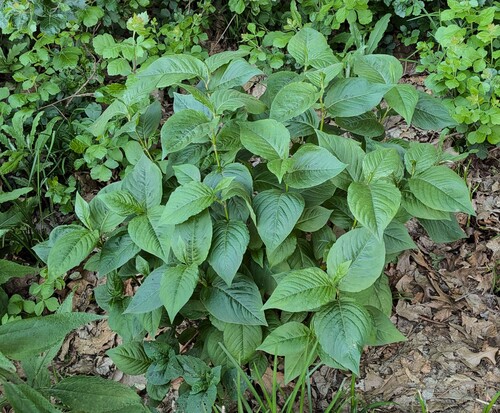
American jumpseed is a fun plant that can grow tall and has pretty green leaves. It loves to grow in shady places and can even jump a little when the seeds are ready to spread!
Habitat: Forests
The American jumpseed has slender stems and oval leaves, often marked with a distinctive dark V-shape. Tiny, pinkish-white flowers grow in long, narrow spikes, appearing delicate and airy.
Category
PlantsRarity
Common
Danger
1/5 · Very low
Snaps
58
It can thrive even in shady spots where many other plants struggle to grow!
Its tiny flowers are so small, you might need a magnifying glass to see them clearly!
The unique "V" shape on its leaves is sometimes called a "cheerleader" mark!
This plant is a distant cousin to rhubarb, a yummy pie ingredient!
American jumpseed has sticky seeds that easily cling to animals or your clothes, helping them travel to new places.
American jumpseed has tough underground stems (rhizomes) allowing it to regrow reliably year after year, even after disturbance.
Apis mellifera
collects nectar and pollen from flowers

Odocoileus virginianus
grazes on the leaves and young stems

Pooecetes gramineus
consumes the small, ripe seeds
Deciduous plants periodically shed all their leaves, typically during autumn or dry seasons.
Flowering plants are any plants that produce flowers as part of their reproductive cycle.
Shade tolerant plants are adapted to grow and thrive in areas with low light levels, requiring less direct sunlight.
Edible plants are those parts of a plant that are considered safe for human consumption.

Fall color refers to the seasonal change in foliage pigmentation, primarily in deciduous plants, displaying vibrant hues.

Describes plants that are particularly attractive and beneficial to a wide range of pollinating organisms.

Forest habitats are terrestrial environments dominated by dense tree cover, supporting a high diversity of plant and animal life.
No aliases listed yet.
Danger
1/5 · Very low
Always explore plants with an adult and don't touch anything you don't know.
The easiest way to identify American jumpseed is to use the Snappit nature identifier app.
30-100 cm
30-60 cm
0.2-0.4 cm
Summer to Fall
Yes
None
Perennial
Zoom in to split clusters and explore where this object has been snapped.
Jun 3, 2026
Louise Arnold Tanger ArboretumPhoto attribution
no rights reserved
License: CC0 1.0 ↗
Image may be shown cropped inside the card frame.

Alabama, US
You might spot Anole, Eastern Gray Squirrel, and Asian Lady Beetle.
View guide →

Pennsylvania, US
You might spot American Robin, Red-Winged Blackbird, and Lesser Celandine.
View guide →

Wisconsin, US
You might spot Turkey, White-Tailed Deer, and Dame's Rocket.
View guide →

Vermont, US
You might spot Asian Bittersweet, Alder Buckthorn, and Eastern Newt.
View guide →

Ohio, US
You might spot Spotted Lanternfly and White-Tailed Deer.
View guide →

Iowa, US
You might spot Common Eastern Bumble Bee and Eastern Cottontail.
View guide →
Take the discovery with you
Snap it with Snappit to identify it, learn what makes it special, and add the discovery to your collection.






.jpg&width=800)



_001.jpg&width=800)


