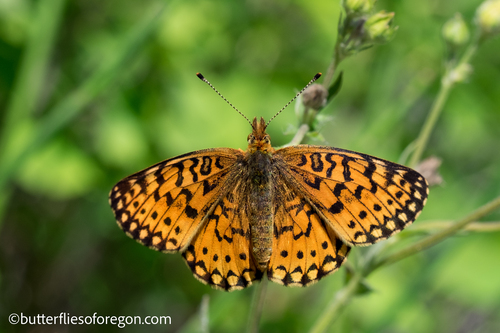


American Silver-Bordered Fritillary
boloria myrina
The American Silver-bordered Fritillary (Boloria myrina) is a charming and easily recognizable butterfly native to North America. Known for its vibrant orange and black upperwings, it gets its common name from the distinctive silvery spots adorning the underside of its hindwings. This medium-sized fritillary is a common sight in moist, open habitats, flitting gracefully among wildflowers. Its life cycle is intrinsically linked to violet plants, which serve as the crucial host for its caterpillars. A strong flyer, it adds a splash of color to meadows and wetlands throughout the summer months, playing an important role as both a pollinator and a food source in its ecosystem, reflecting the health of its preferred moist habitats.
Habitat: Found predominantly in moist, open environments such as wet meadows, bogs, marshes, open woodlands, and along stream banks.
This butterfly features bright orange upperwings heavily patterned with distinct black spots and a prominent black border. The forewings are more pointed than many other fritillaries. The most striking identifier is on the underside of the hindwing, which displays a series of iridescent, rectangular silver spots set against a reddish-brown and yellowish-orange background, bordered by a zigzag black line. Its wingspan typically ranges from 3.8 to 5.7 centimeters.
Category
InsectsRarity
Common
Danger
1/5 · Very low
Snaps
Be the first to snap!
It belongs to the Nymphalidae family, also known as the brush-footed butterflies, due to their reduced forelegs that resemble brushes and are used for sensory purposes.
The distinct silvery spots on the underside of its hindwings are a key identification feature and give the butterfly its common name.
The species typically overwinters as a partially grown caterpillar, resuming feeding and development the following spring once host plants become available.
Unlike many butterflies, its caterpillars have spiny bodies, a common trait among fritillaries, believed to deter some predators.
Larvae exclusively feed on the leaves of violet plants (Viola spp.), making their survival directly dependent on the presence of these specific host plants in their habitat.
The iridescent silver spots on the underside of its hindwings may serve as a form of disruptive camouflage, helping to break up its outline or reflect light in a way that confuses predators when at rest.
Produces two to three generations per year in many parts of its range, allowing it to rapidly reproduce and take advantage of favorable conditions throughout the warmer months.
Adult American Silver-bordered Fritillaries are nectivores, primarily feeding on nectar from a variety of wildflowers to fuel their flight. Their caterpillars are obligate herbivores, consuming the leaves of violet plants for growth and development.
Age differences: Larvae feed on violet leaves, while adults feed on flower nectar.
No trait badges are assigned for this object yet.
No aliases listed yet.
Collections for this object will appear here as more themes are added.
Danger
1/5 · Very low
No special safety notes yet.
The easiest way to identify American Silver-Bordered Fritillary is to use the Snappit nature identifier app.
1-2 cm
3-5 cm
0.0003-0.0005 kg
0-1 years
15 km/h
Adult American Silver-bordered Fritillaries are nectivores, primarily feeding on nectar from a variety of wildflowers to fuel their flight. Their caterpillars are obligate herbivores, consuming the leaves of violet plants for growth and development.
Found predominantly in moist, open environments such as wet meadows, bogs, marshes, open woodlands, and along stream banks.
Zoom in to split clusters and explore where this object has been snapped.
Recent snaps will appear here as new observations are added.
Take the discovery with you
Snap it with Snappit to identify it, learn what makes it special, and add the discovery to your collection.











.jpg&width=800)




