

American Snout
libytheana carinenta
The American Snout (Libytheana carinenta) is a remarkable and uniquely shaped butterfly best known for its prominent, elongated mouthparts that form a distinct "snout." Belonging to the brush-footed butterfly family, this species is a master of disguise, utilizing complex wing patterns and shapes to mimic dead leaves perfectly. Beyond its intriguing appearance, the American Snout is famous for its spectacular and unpredictable mass migrations. During certain years, population explosions triggered by specific weather patterns lead to millions of these butterflies taking to the skies in dark, cloud-like swarms. These breathtaking flights are a testament to the dynamic nature of insect life cycles and remain one of the most astonishing spectacles in the natural world.
Habitat: Found in open woodlands, brushy areas, and forest edges, particularly in regions where hackberry trees are abundant.
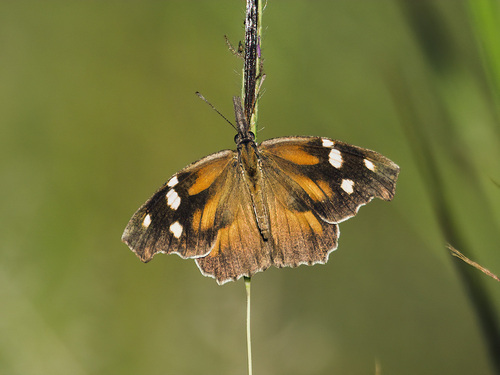
This medium-sized butterfly has a wingspan of 3.5 to 5 centimeters. The most defining feature is its long, beak-like snout, which is composed of elongated labial palpi protruding from its head. The upper side of the wings is boldly patterned in black or dark brown with striking orange patches and white spots near the tips of the forewings. The underside of the wings is a mottled, dull brown and gray that flawlessly resembles a dried, dead leaf, complete with a dark line resembling a leaf vein. The forewings feature a distinctive squared-off tip, further enhancing its leafy disguise when resting.
Category
InsectsRarity
Common
Danger
1/5 · Very low
Snaps
9
During massive population booms in Texas, swarms of American Snouts have been so dense that they block out the sun and cause streetlights to turn on during the day.
The snout is not actually a nose, but rather highly elongated labial palps, which are mouthparts covered in sensory receptors.
When frightened, the American Snout will often drop out of the air and fall directly into the leaf litter below, playing dead to become completely invisible to predators.
When resting with its wings closed, the butterfly perfectly mimics a dry leaf, utilizing its squared forewing tips and mottled brown underside to hide from predators.
Capable of forming massive migratory swarms in late summer, with millions of individuals traveling together in numbers dense enough to obscure the sun.
Possesses specially adapted, highly elongated mouthparts that form a snout which helps break up its outline and enhances its dead-leaf camouflage.
Caterpillars exclusively consume the foliage of hackberry trees, while adult butterflies feed on nectar from various flowers and extract minerals from damp soil.
Age differences: Larvae are obligate leaf-eaters (folivores), whereas adults shift entirely to a liquid diet of nectar and dissolved minerals.
No trait badges are assigned for this object yet.
No aliases listed yet.
Collections for this object will appear here as more themes are added.
Danger
1/5 · Very low
No special safety notes yet.
The easiest way to identify American Snout is to use the Snappit nature identifier app.
1-2 cm
3-5 cm
0.0001-0.0003 kg
0 years
20 km/h
Caterpillars exclusively consume the foliage of hackberry trees, while adult butterflies feed on nectar from various flowers and extract minerals from damp soil.
Found in open woodlands, brushy areas, and forest edges, particularly in regions where hackberry trees are abundant.
Zoom in to split clusters and explore where this object has been snapped.

US
You might spot Wharf Louse, Osprey, and Ruddy Turnstone.
View guide →

New York, US
You might spot White Snakeroot, Rock Pigeon, and Eastern Gray Squirrel.
View guide →

Arizona, US
You might spot Christmas Cholla and California Barrel Cactus.
View guide →

New York, US
You might spot White Snakeroot, Rock Pigeon, and Eastern Gray Squirrel.
View guide →

Missouri, US
You might spot Eastern Carpenter Bee, Duck, and American Robin.
View guide →

Pennsylvania, US
You might spot Harlequin Bug, White-Tailed Deer, and Bee.
View guide →
Take the discovery with you
Snap it with Snappit to identify it, learn what makes it special, and add the discovery to your collection.














.jpg&width=800)




