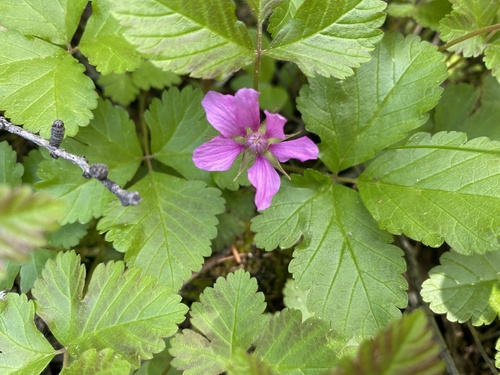


Arctic Raspberry
rubus arcticus
The Arctic Raspberry (Rubus arcticus), also known as the arctic bramble or crimson bramble, is a miniature treasure of the far north. This diminutive, herbaceous perennial belongs to the rose family and is celebrated for its exceptionally flavorful, dark red berries, which are often called the "prince of berries." Unlike many of its prickly relatives, this plant entirely lacks thorns, making it a friendly encounter for foragers exploring boreal woodlands and muskegs. It thrives in cold subarctic climates, where its low-growing stature protects it from freezing winds under a insulating blanket of winter snow. In late spring, the plant blankets the forest floor with beautiful pinkish-purple blossoms that give way to aggregate fruits possessing a rich, complex aroma reminiscent of raspberries, strawberries, and pineapples.
Habitat: Found in damp, acidic soils of boreal forests, peat bogs, muskegs, and subarctic tundra meadows across the Northern Hemisphere.
The Arctic Raspberry is a low-lying, creeping plant reaching only 10 to 30 centimeters in height, spreading via underground rhizomes rather than tall, upright canes. Its trifoliate leaves are bright green with coarsely toothed margins and deep veins, turning a striking bronze-red in the autumn. The flowers feature five to eight showy, vibrant magenta-pink petals surrounding a crown of yellow stamens. The fruit is a small, glossy cluster of dark red to deep purple drupelets that sits nestled directly against the leaves and, unlike a true raspberry, does not pull away from its core when harvested.
Category
PlantsRarity
Common
Danger
1/5 · Very low
Snaps
1
Despite belonging to the same genus as heavily armored blackberries and raspberries, this species is entirely smooth and thornless.
It is the provincial flower of Norrbotten, the northernmost province of Sweden, where the berries are prized for making artisanal liqueurs.
The legendary taxonomist Carl Linnaeus considered the Arctic Raspberry a great delicacy and wrote that it saved him from starvation during his Lapland expedition in 1732.
Lacks defensive thorns, instead investing energy into a low-profile growth habit that utilizes winter snowpack for protection against extreme freezing temperatures.
Spreads via an extensive network of creeping underground woody rhizomes, allowing it to quickly regenerate and colonize areas after forest fires.
Produces highly concentrated sugars in its sap and flowers, lowering the freezing point to protect delicate tissues during sudden late-spring frosts.
As a photosynthetic plant, the Arctic Raspberry manufactures its own food using sunlight, water, and carbon dioxide.
Bombus polaris
Relies on northern bumblebee species for pollination during the brief arctic summer.

Ursus arctos
The nutrient-dense berries are consumed by bears, which subsequently disperse the seeds in new locations via their scat.
Phytophthora fragariae
Can be infected by soil-borne oomycetes that cause destructive root rot in damp habitats.
No trait badges are assigned for this object yet.
No aliases listed yet.
Collections for this object will appear here as more themes are added.
Danger
1/5 · Very low
No special safety notes yet.
The easiest way to identify Arctic Raspberry is to use the Snappit nature identifier app.
10-30 cm
0.01-0.05 kg
5-15 years
As a photosynthetic plant, the Arctic Raspberry manufactures its own food using sunlight, water, and carbon dioxide.
Found in damp, acidic soils of boreal forests, peat bogs, muskegs, and subarctic tundra meadows across the Northern Hemisphere.
90-180 days
Zoom in to split clusters and explore where this object has been snapped.

US
You might spot Bald Eagle, Common Raven, and Salmonberry.
View guide →

Alaska, US
You might spot Brown Bear, American Beaver, and Arctic Raspberry.
View guide →
Alaska, US
You might spot Brown Bear, American Beaver, and Arctic Raspberry.
View guide →
Take the discovery with you
Snap it with Snappit to identify it, learn what makes it special, and add the discovery to your collection.











.jpg&width=800)



_001.jpg&width=800)




