


Bambusa
bambusa
Bambusa is a diverse genus of clumping bamboo, primarily native to the tropical and subtropical regions of Asia. Characterized by their fast-growing, woody stems known as culms, these plants form dense, majestic groves that define many Asian forest landscapes. Unlike running bamboos, Bambusa species possess sympodial rhizomes, meaning they grow in tight, predictable clumps, making them highly valued for both ecological soil stability and controlled ornamental landscaping. Globally, Bambusa has been indispensable to humanity. Its incredible strength, flexibility, and rapid growth rate make it a premier renewable resource used for constructing scaffolding, bridges, musical instruments, and paper, while its tender shoots remain a culinary staple.
Habitat: Typically found in tropical and subtropical monsoon forests, riverbanks, and moist valleys, thriving in well-drained, fertile soils.
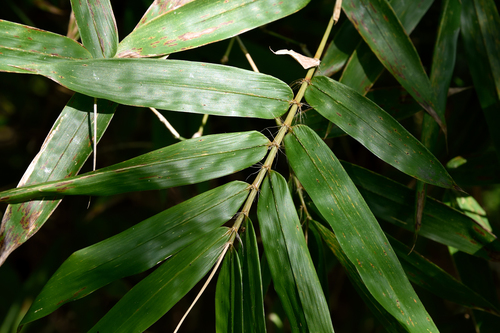
Bambusa plants are easily identified by their towering, hollow green or yellow culms that grow in dense, circular clumps. Depending on the species, mature culms range from bright emerald green to deep gold, often featuring distinctive dark green vertical striping near the ring-like nodes. Branching typically occurs from these nodes along the upper half of the stem, producing delicate, lance-shaped leaves with fine parallel veins. Young shoots emerge from the soil wrapped in dark, hairy, paper-like sheaths that shed as the culm matures.
Category
PlantsRarity
Common
Danger
1/5 · Very low
Snaps
Be the first to snap!
Bambusa plants often exhibit gregarious flowering, where all members of a single clone line bloom simultaneously worldwide before dying off.
The silica-rich outer layer of Bambusa culms is so dense and tough that it can cause sparks when struck with steel blades.
Under optimal conditions, certain species within the Bambusa genus can grow up to 91 centimeters (36 inches) in a single 24-hour period.
Utilizes pressurized cellular expansion driven by water to grow several decimeters in a single day under optimal conditions.
Maintains an extensive underground root system that shares nutrients, water, and biochemical signals across the entire colony.
Produces cell walls heavily reinforced with silica, giving the mature woody stems a strength-to-weight ratio that rivals steel.
Like all green plants, Bambusa species are autotrophic, synthesizing their own energy from sunlight, water, and carbon dioxide through photosynthesis.
Age differences: Young shoots rely heavily on nutrients stored in the maternal rhizome network, while mature culms photosynthesize independently.

Ailuropoda melanoleuca
Giant pandas feed almost exclusively on the leaves, shoots, and stems of bamboo species, including those in this genus.
Pseudoregma bambucicola
Feeds on the sap of young bamboo shoots, sometimes secreting honeydew that attracts protective ant species.
Glomus intraradices
Colonizes the root system of the bamboo, dramatically enhancing nutrient absorption in exchange for plant-produced carbohydrates.
No trait badges are assigned for this object yet.
No aliases listed yet.
Collections for this object will appear here as more themes are added.
Danger
1/5 · Very low
No special safety notes yet.
Compare seed heads, stem shape, how leaves attach, and the joint where leaf meets stem. A patch of mown lawn rarely shows enough for an exact ID. Grass Identifier: upload a photo and compare the visible details.
100-3000 cm
5-80 kg
20-120 years
Like all green plants, Bambusa species are autotrophic, synthesizing their own energy from sunlight, water, and carbon dioxide through photosynthesis.
Typically found in tropical and subtropical monsoon forests, riverbanks, and moist valleys, thriving in well-drained, fertile soils.
Photosynthesis
Zoom in to split clusters and explore where this object has been snapped.
Recent snaps will appear here as new observations are added.
Take the discovery with you
Snap it with Snappit to identify it, learn what makes it special, and add the discovery to your collection.

















