





Banteng
Bos javanicus
The Banteng is a majestic wild cow with a striking appearance. They have a dark brown coat and distinctive white 'stockings' on their legs. Bantengs are known for their strong herding instincts and graceful movements.
Habitat: Forest
The Banteng has a striking appearance with its reddish-brown to black coat, males being darker than females. Both sexes feature distinctive white "stockings" on their lower legs, a prominent white rump patch, and white around the muzzle. They also possess impressive, curving horns.
Category
MammalsRarity
Rare
Danger
2/5 · Low
Snaps
Be the first to snap!
Bantengs can live up to 30 years, an impressive lifespan for a wild bovine!
Male Bantengs are born reddish, but their fur darkens to black as they grow up!
The Banteng is the wild ancestor of Bali cattle, a unique domesticated livestock.
Their white rump patch helps herd members follow each other through dense forest.
Banteng has powerful legs and hooves that help them move easily through dense jungle undergrowth and rugged terrain.
Banteng can eat coarse grasses and woody plants because of their specialized four-chambered stomach, extracting nutrients efficiently.
Banteng has keen hearing and a strong sense of smell that helps them detect predators and find food in their forest habitat.
Bantengs are herbivores that love to munch on a variety of plants.
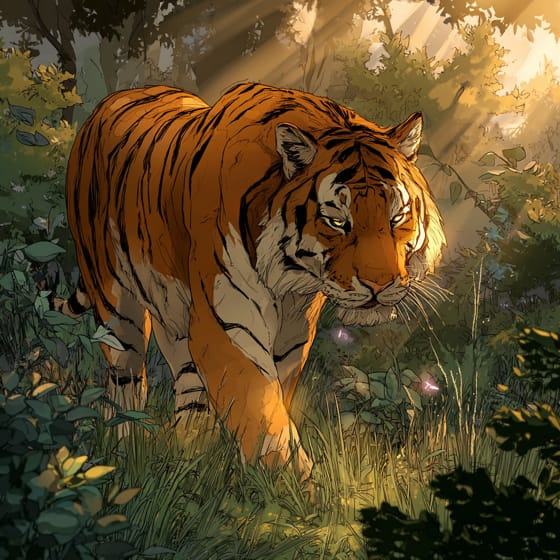
Panthera tigris
A primary predator, especially of young or weak Bantengs.
_cropped.jpg&width=800)
Cuon alpinus
Packs of dholes can hunt and take down Bantengs.
Bambusa vulgaris
A common food source, especially in forest habitats.
Imperata cylindrica
One of the preferred grass species grazed by Bantengs.
Wildlife encompasses all undomesticated animal and plant life existing in their natural habitats.
Furry describes animals possessing a dense covering of soft hair or fur.
Social animals live in organized groups, cooperating for survival benefits such as foraging, defense, and raising offspring.
Characterized by having one or more hard, permanent, pointed projections on the head.

Colorful describes organisms or objects displaying a wide range of bright and distinct colors.

This trait characterizes organisms whose diet consists entirely or primarily of plant material.

Forest habitats are terrestrial environments dominated by dense tree cover, supporting a high diversity of plant and animal life.

Describes a species whose presence and role have a disproportionately large effect on its environment.
Danger
2/5 · Low
Admire Bantengs from a safe distance and never approach them in the wild.
The easiest way to identify Banteng is to use the Snappit nature identifier app.
180-230 cm
400-1000 kg
20-30 years
50 km/h
Bantengs are herbivores that love to munch on a variety of plants.
Forest
Grazing
Zoom in to split clusters and explore where this object has been snapped.
Recent snaps will appear here as new observations are added.
Take the discovery with you
Snap it with Snappit to identify it, learn what makes it special, and add the discovery to your collection.





.jpg&width=800)



.JPG&width=800)


.jpg&width=800)
