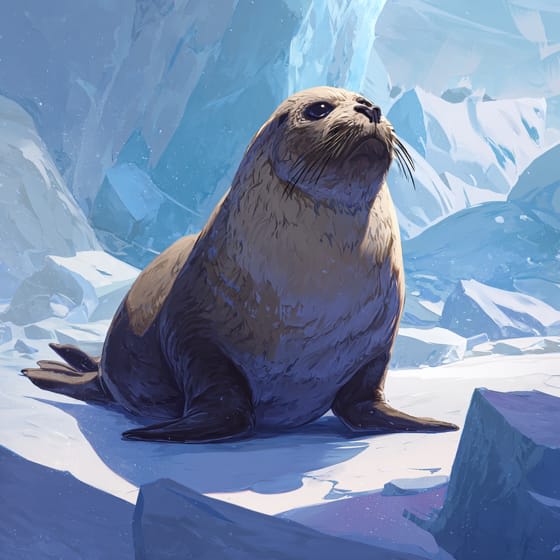





Bearded Seal
Erignathus barbatus
Bearded seals are friendly animals that love to swim in cold ocean waters. They have whiskers that look like beards, which help them feel around in the water.
The Bearded Seal is a large, robust seal with a relatively small head. It has short, brownish-gray fur and famously long, pale, bristly whiskers that resemble a shaggy beard. Its powerful body tapers to broad hind flippers.
Category
MammalsRarity
Common
Danger
2/5 · Low
Snaps
Be the first to snap!
Pups are born with a furry coat that helps them float on water easily!
Their scientific name, *Erignathus barbatus*, means 'deep-jawed bearded one'.
They hum and trill underwater, making unique, echoing songs!
Unlike other seals, they use all four flippers to swim slowly underwater.
Bearded Seal can use its thick skull and powerful fore-flippers to break through ice for breathing holes.
Bearded Seal can hold its breath for long periods, allowing it to dive deep to find food below the surface.
They munch on small creatures found on the seafloor, like shrimp, crabs, and bottom-dwelling fish.
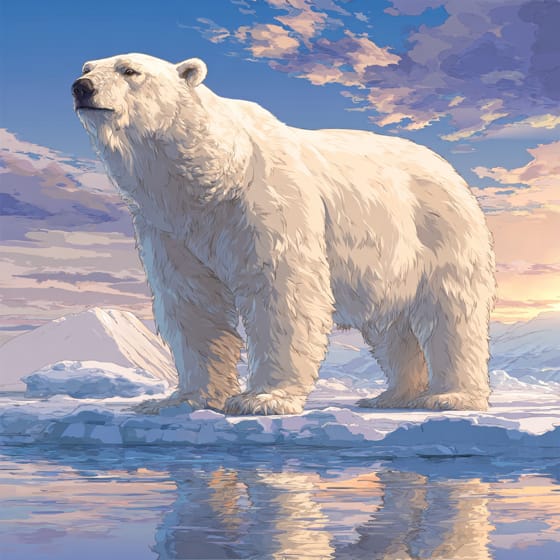
Ursus maritimus
Major predator hunting seals on the ice.
Orcinus orca
Marine apex predator, occasionally hunts seals.
Boreogadus saida
Common fish prey found on the seafloor.
Chionoecetes opilio
Crabs are a favorite food of these seals.
Wildlife encompasses all undomesticated animal and plant life existing in their natural habitats.
Furry describes animals possessing a dense covering of soft hair or fur.
Possessing prominent sensory hairs or vibrissae, often around the snout.
Social animals live in organized groups, cooperating for survival benefits such as foraging, defense, and raising offspring.

Piscivorous organisms are animals that primarily subsist on a diet of fish.

Coastal habitats are dynamic environments located along the interface between land and sea, influenced by tides, waves, and saltwater.

Aquatic habitats encompass environments where organisms live predominantly in water, including oceans, rivers, lakes, and wetlands.
Danger
2/5 · Low
Bearded seals are wild animals and should be admired from a distance. Always respect their space in nature.
The easiest way to identify Bearded Seal is to use the Snappit nature identifier app.
210-270 cm
200-360 kg
20-25 years
10 km/h
They munch on small creatures found on the seafloor, like shrimp, crabs, and bottom-dwelling fish.
Foraging
1
Zoom in to split clusters and explore where this object has been snapped.
Recent snaps will appear here as new observations are added.
Take the discovery with you
Snap it with Snappit to identify it, learn what makes it special, and add the discovery to your collection.




.jpg&width=800)



.JPG&width=800)



.jpg&width=800)
