4.jpg&width=800)





Bee Balm
Monarda didyma
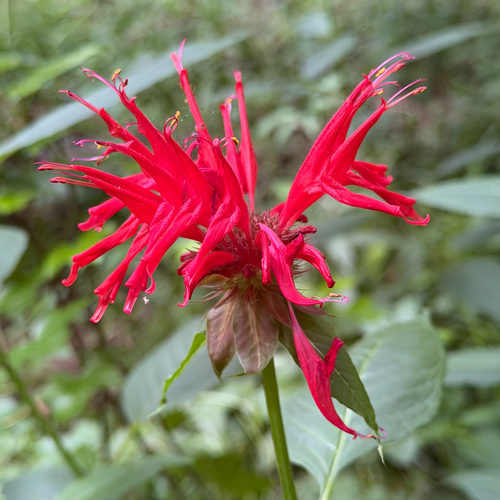
Bee Balm is a vibrant flower that attracts bees and butterflies with its sweet nectar. Its bright red blooms add color to gardens and meadows, making it a favorite among pollinators.
Habitat: Gardens, Meadows
The Bee Balm has vibrant, shaggy flower heads made of many tubular petals, often appearing in shades of red, pink, or purple. Its unique blossoms sit atop square stems, distinctively different from many other garden flowers. The leaves are pointed and slightly toothed.
Category
PlantsRarity
Common
Danger
2/5 · Low
Snaps
5
Bee Balm is a mint family plant, easily identified by its square stems!
Deer usually avoid eating this plant because of its strong, aromatic scent!
Its scientific name, Monarda, honors a Spanish botanist from the 1500s!
The 'flower' is actually a cluster of many tiny, tube-shaped individual flowers!
Bee Balm has bright, tubular flowers packed with nectar that act like a giant beacon, signaling hungry hummingbirds and bees to a delicious meal.
Bee Balm leaves contain aromatic oils, giving it a spicy scent that helps deter some hungry deer and other plant-eating critters from munching on them.
Bee Balm can spread underground using rhizomes, allowing it to quickly form dense colonies and compete successfully with other plants in its habitat.

Bombus impatiens
Gathers nectar and pollen from the flowers.

Archilochus colubris
Sips nectar using its long beak.
Apis mellifera
Collects nectar and some pollen.
Tetranychus urticae
Feeds on Bee Balm leaves.
Spring blooming plants produce their flowers during the spring season, often signifying the end of winter and the start of new growth.
Fragrant flowers emit a pleasant aroma, often to attract pollinators or for defense.
Medicinal plants possess chemical compounds that can be used for therapeutic purposes to treat illnesses or maintain health.
Describes plants that are particularly attractive and beneficial to a wide range of pollinating organisms.

Describes a species whose presence and role have a disproportionately large effect on its environment.

Describes organisms that transfer pollen, enabling the fertilization and reproduction of plants.
Danger
2/5 · Low
Enjoy the beauty of Bee Balm from a safe distance and avoid touching or ingesting any part of the plant.
The easiest way to identify Bee Balm is to use the Snappit nature identifier app.
60-150 cm
60-90 cm
2-4 cm
Summer
Yes
None
Perennial
Zoom in to split clusters and explore where this object has been snapped.
Jun 6, 2026
Candler Park Historic DistrictPhoto attribution
(c) Dan Vickers, some rights reserved (CC BY)
License: CC BY 4.0 ↗
Image may be shown cropped inside the card frame.

Ohio, US
You might spot Spotted Lanternfly and White-Tailed Deer.
View guide →

North Carolina, US
You might spot Northern Cardinal, Carolina Wren, and Tufted Titmouse.
View guide →

Virginia, US
You might spot Eastern Tiger Swallowtail, Fowler's Toad, and Monarch.
View guide →

West Virginia, US
You might spot Virginia Bluebells, Bloodroot, and Maidenhair Spleenwort.
View guide →

Georgia, US
You might spot Anole, Asian Lady Beetle, and Joro Spider.
View guide →

Pennsylvania, US
You might spot Eastern Skunk Cabbage and American Hornbeam.
View guide →
Take the discovery with you
Snap it with Snappit to identify it, learn what makes it special, and add the discovery to your collection.









.jpg&width=800)


_001.jpg&width=800)




