
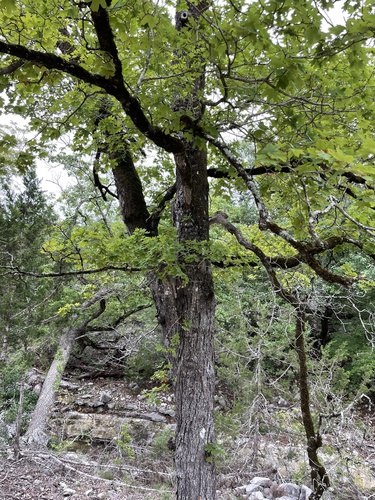


Bigtooth Maple
acer grandidentatum
The Bigtooth Maple, also known as the canyon maple, is a stunning deciduous tree native to the interior highlands and canyons of western North America. Renowned for its spectacular autumn display, this tree lights up rugged rocky landscapes with vibrant shades of red, orange, and gold, bringing a taste of classic autumn colors to the arid American West. It is closely related to the sugar maple, and like its eastern cousin, its sap can be tapped to make sweet syrup. Growing slowly but steadily in well-drained, alkaline soils, the Bigtooth Maple provides crucial cover and sustenance for various montane wildlife. Its leaves, twigs, and seeds feed local birds and mammals, while its dense canopy offers shade and nesting sites in dry canyon environments.
Habitat: Typically found in moist canyons, ravines, and mountain slopes, often alongside mountain streams in arid regions of western North America.
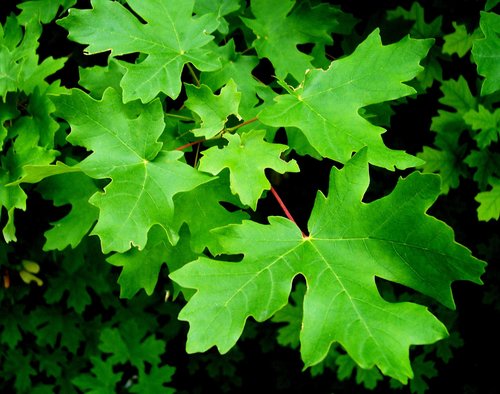
The Bigtooth Maple is a small to medium-sized tree, typically growing 8 to 15 meters tall, often displaying a multi-trunked growth habit in drier soils. It features characteristic three- to five-lobed leaves with large, blunt teeth that are dark green on top and pale, fuzzy underneath. In spring, it produces clusters of small, dangling yellow-green flowers. By late summer, it develops paired, winged seeds called samaras that spread at a wide angle. Its bark is thin, smooth, and grey on young trees, eventually becoming dark brown and plate-like with age.
Category
PlantsRarity
Common
Danger
1/5 · Very low
Snaps
Be the first to snap!
In autumn, canyons populated by this species create a dramatic visual contrast, often referred to as 'canyon fire' because of the intense red and orange hues.
Its sap contains a high concentration of sugar, and early pioneers and Native Americans tapped the tree to produce a sweet syrup similar to eastern sugar maple syrup.
Unlike most maples that prefer humid climates, the Bigtooth Maple is highly adapted to the alkaline soils and arid environments of the Rocky Mountains.
Unlike many maple species, it has adapted to thrive in semi-arid environments, utilizing deep root systems and efficient water retention strategies to survive hot, dry summers.
It undergoes a dramatic chemical change in autumn, converting sugars into anthocyanins and carotenoids to produce exceptionally bright red, orange, and yellow foliage.
It produces high-sugar sap that flows during late winter thaw cycles, allowing it to heal internal tissues and ward off freezing temperatures.
As a photosynthetic plant, the Bigtooth Maple generates its own energy from sunlight, water, and carbon dioxide, while absorbing essential minerals from the soil.

Odocoileus hemionus
Mule deer browse on the twigs and leaves of the tree, especially during the winter months.

Tamiasciurus hudsonicus
American red squirrels feed on the winged seeds during the late summer and autumn.
Glomeromycota
Establishes symbiotic mycorrhizal relationships with subterranean fungi to enhance water and nutrient absorption in arid soils.
No trait badges are assigned for this object yet.
No aliases listed yet.
Collections for this object will appear here as more themes are added.
Danger
1/5 · Very low
No special safety notes yet.
Start with the whole plant, then compare leaf arrangement, leaf edges, stems and any flowers or fruit. Opposite leaves grow in pairs; alternate leaves come one at a time along the stem. These details tell you far more together than a single green leaf does. Plant Identifier: upload a photo and compare the visible details.
800-1500 cm
80-150 years
As a photosynthetic plant, the Bigtooth Maple generates its own energy from sunlight, water, and carbon dioxide, while absorbing essential minerals from the soil.
Typically found in moist canyons, ravines, and mountain slopes, often alongside mountain streams in arid regions of western North America.
Zoom in to split clusters and explore where this object has been snapped.
Recent snaps will appear here as new observations are added.

Utah, US
You might spot Duck, Gambel Oak, and Box Elder.
View guide →
Texas, US
You might spot Bigtooth Maple, Texas Madrone, and Scarlet Leather Flower.
View guide →

Utah, US
You might spot Duck, Gambel Oak, and Box Elder.
View guide →
Take the discovery with you
Snap it with Snappit to identify it, learn what makes it special, and add the discovery to your collection.

















