





American Red Squirrel
Tamiasciurus hudsonicus
The American Red Squirrel is a small, lively animal with a fluffy tail and bright red fur. They love to climb trees and gather nuts to eat during the winter.
Habitat: Forests
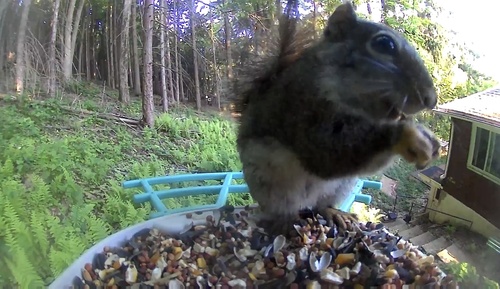
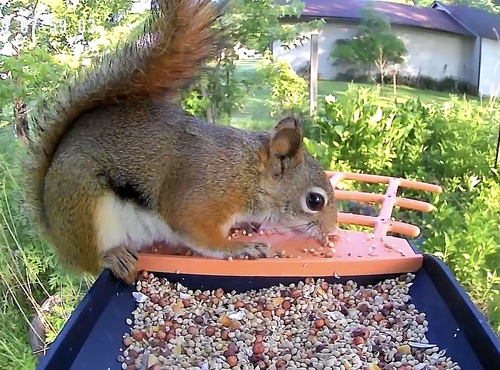
The American Red Squirrel has a distinct reddish-brown back contrasting with a white belly and a clear white ring around its eyes. It is notably smaller than Grey Squirrels, boasting a bushy tail often edged in white. Its pointed ears may sport small tufts in colder months.
Category
MammalsRarity
Common
Danger
1/5 · Very low
Snaps
57
Red squirrels are fierce defenders of their food stashes, chasing away intruders!
Their front teeth never stop growing, so they chew constantly to keep them short.
They build "middens," huge piles of cone scales, some are ancient!
They can collect and store thousands of pinecones in one season!
American Red Squirrel can find buried food using its keen sense of smell, helping them survive harsh winters.
American Red Squirrel has a wide range of vocalizations that helps them communicate warnings and territorial claims effectively.
American Red Squirrel has strong jaws and sharp teeth that help them efficiently strip pinecones to access seeds.
American Red Squirrel can quickly maneuver through trees and branches, helping them escape predators and find food.
These tiny foragers love to eat seeds from cones, nuts, and even some fungi!
Furry describes animals possessing a dense covering of soft hair or fur.
Social animals live in organized groups, cooperating for survival benefits such as foraging, defense, and raising offspring.
Arboreal animals live primarily in trees, utilizing them for shelter, food, and protection from predators.
This trait characterizes organisms whose diet consists entirely or primarily of plant material.

Forest habitats are terrestrial environments dominated by dense tree cover, supporting a high diversity of plant and animal life.

Diurnal animals are primarily active during daylight hours, typically resting or sleeping at night.

This trait identifies organisms that exhibit exceptional swiftness in movement for hunting, escape, or travel.
No aliases listed yet.
Danger
1/5 · Very low
Watch squirrels from a distance and don't try to touch them, as they can be shy.
The easiest way to identify American Red Squirrel is to use the Snappit nature identifier app.
28-35 cm
0.19-0.28 kg
2-7 years
24 km/h
These tiny foragers love to eat seeds from cones, nuts, and even some fungi!
Forests
Foraging
Zoom in to split clusters and explore where this object has been snapped.
Jun 15, 2026
Sitka National Historical ParkPhoto attribution
(c) Ace, some rights reserved (CC BY)
License: CC BY 4.0 ↗
Image may be shown cropped inside the card frame.
Jun 3, 2026
Binghamton Zoo at Ross ParkPhoto attribution
(c) David Weisenbeck, some rights reserved (CC BY)
License: CC BY 4.0 ↗
Image may be shown cropped inside the card frame.
May 29, 2026
Gardenview Horticultural ParkPhoto attribution
(c) fuzzyspider, some rights reserved (CC BY)
License: CC BY 4.0 ↗
Image may be shown cropped inside the card frame.
Feb 15, 2026
Kettle Falls Historic DistrictPhoto attribution
(c) Curtis Meyers, some rights reserved (CC BY-SA)
License: CC BY-SA 4.0 ↗
Image may be shown cropped inside the card frame.
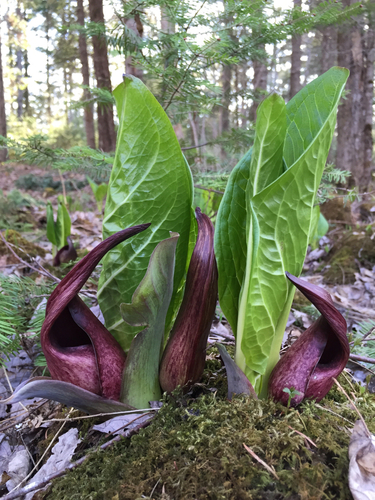
Connecticut, US
You might spot Eastern Skunk Cabbage and Eastern White Pine.
View guide →

Maine, US
You might spot American Bullfrog and Three-Toothed Cinquefoil.
View guide →

Alaska, US
You might spot Cliff Swallow, Pretty Jacob's-Ladder, and Dwarf Fireweed.
View guide →

US
You might spot Bald Eagle, Common Raven, and Salmonberry.
View guide →

Wisconsin, US
You might spot Eastern Redcedar, Rock Polypody, and Vulture.
View guide →

Connecticut, US
You might spot Garlic Mustard and Common Eastern Bumble Bee.
View guide →
Take the discovery with you
Snap it with Snappit to identify it, learn what makes it special, and add the discovery to your collection.





.jpg&width=800)
.jpg&width=800)

.JPG&width=800)


.jpg&width=800)
