


Black Locust
Robinia pseudoacacia
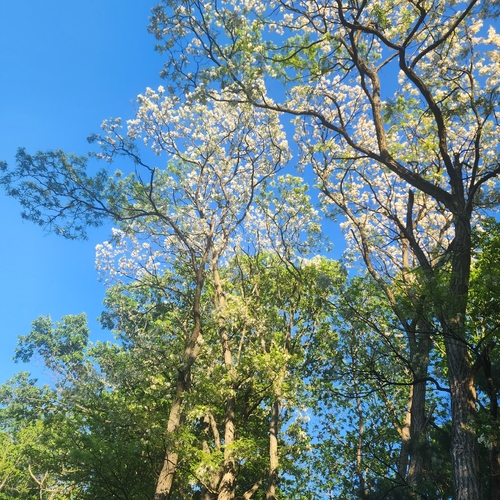
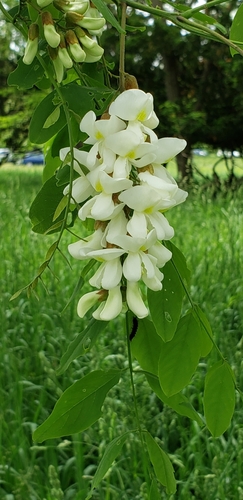
The Black Locust tree has white flowers that smell sweet like perfume. Its bark is rough and dark, and it grows tall with strong wood that's good for building things.
Habitat: Forests
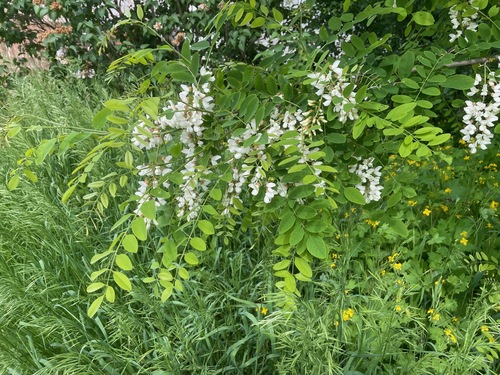
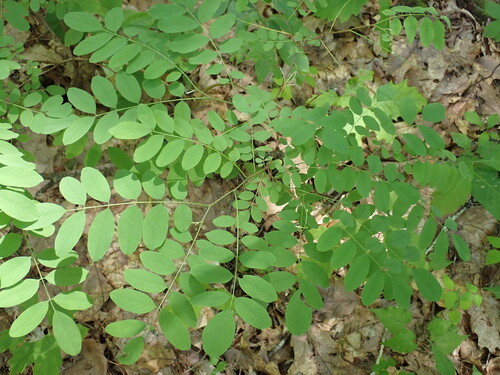
The Black Locust is a fast-growing tree with rough, deeply furrowed, dark gray-brown bark. It has thorny twigs and long, compound leaves with many small, oval leaflets. In late spring, it produces drooping clusters of fragrant, pea-like white flowers.
Category
TreesRarity
Common
Danger
2/5 · Low
Snaps
35
Believe it or not, this tree is actually related to garden peas and beans!
Black Locust flowers smell wonderfully sweet, attracting bees to make delicious honey!
Its wood is incredibly dense, making it North America's hardest and most durable!
This tree can sprout new trees from its roots, forming entire groves!
Black Locust enriches poor soil; it has root bumps with bacteria that create nitrogen, a vital plant food!
Black Locust has sharp thorns on its branches, helping defend against animals trying to eat its leaves or bark.
Black Locust grows in disturbed areas, like old fields, because it easily sprouts from roots and spreads quickly.
Apis mellifera
collects nectar for honey
Rhizobium leguminosarum
lives in root nodules, fixing nitrogen
Megacyllene robiniae
larvae tunnel into its wood

Phyllonorycter robiniella
larvae feed on its leaves
Deciduous plants periodically shed all their leaves, typically during autumn or dry seasons.
Describes organisms capable of converting atmospheric nitrogen into compounds usable by plants.
Shade tolerant plants are adapted to grow and thrive in areas with low light levels, requiring less direct sunlight.
Broadleaf trees are angiosperms characterized by flat, wide leaves that are typically shed annually in temperate climates.

Fragrant flowers emit a pleasant aroma, often to attract pollinators or for defense.

Rapid growing plants exhibit accelerated growth rates, quickly increasing in size and biomass within a short period.

Timber refers to wood that has been prepared for use in building and carpentry.

Forest habitats are terrestrial environments dominated by dense tree cover, supporting a high diversity of plant and animal life.

This trait characterizes organisms with an exceptionally long lifespan compared to others of their kind.
Danger
2/5 · Low
Enjoy looking at Black Locust trees from a safe distance and avoid climbing them.
The easiest way to identify Black Locust is to use the Snappit nature identifier app.
12-25 m
6-12 m
No
30-90 cm
50-100 years
Forests
Legume pod
Zoom in to split clusters and explore where this object has been snapped.
Jun 5, 2026
Battery Street Historic DistrictPhoto attribution
(c) Tom Scavo, some rights reserved (CC BY)
License: CC BY 4.0 ↗
Image may be shown cropped inside the card frame.
May 11, 2026
Haym Salomon Memorial ParkPhoto attribution
(c) i_da_naturalist, some rights reserved (CC BY)
License: CC BY 4.0 ↗
Image may be shown cropped inside the card frame.
Jul 4, 2025
Chesterfield GorgePhoto attribution
no rights reserved
License: CC0 1.0 ↗
Image may be shown cropped inside the card frame.
May 28, 2022
LinwoodPhoto attribution
(c) Judy Dobles, some rights reserved (CC BY)
License: CC BY 4.0 ↗
Image may be shown cropped inside the card frame.

New Jersey, US
You might spot Garlic Mustard, Sensitive Fern, and Common Mugwort.
View guide →

New Jersey, US
You might spot Brant, Laughing Gull, and Great Black-Backed Gull.
View guide →

Connecticut, US
You might spot American Robin, Eastern Poison Ivy, and Duck.
View guide →

Maine, US
You might spot American Bullfrog and Three-Toothed Cinquefoil.
View guide →

Massachusetts, US
You might spot Mountain Laurel, Azure Bluet, and Partridgeberry.
View guide →

Ohio, US
You might spot Blue-Fronted Dancer, American Rubyspot, and Fowler's Toad.
View guide →
Take the discovery with you
Snap it with Snappit to identify it, learn what makes it special, and add the discovery to your collection.