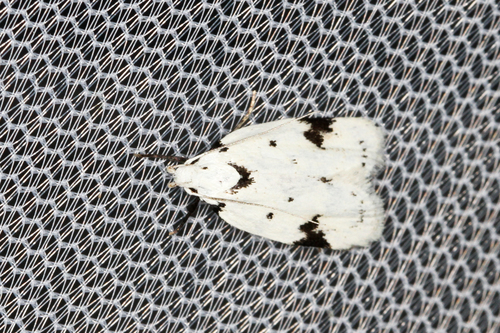


Black-Marked Inga Moth
inga sparsiciliella
The Black-Marked Inga Moth is a fascinating, yet often overlooked, member of the concealer moth family known as Oecophoridae. Native to the woodlands of North America, this small moth plays an important role in forest ecosystems as part of the detritivore and herbivore communities during its larval stage. While adults are delicate, unassuming flyers, they serve as an essential food source for a variety of nocturnal predators like bats and spiders. Their subtle beauty and interesting life cycle make them a wonderful find for insect enthusiasts peering into the nocturnal world.
Habitat: Found primarily in deciduous woodlands and mixed forests, particularly where there is an abundance of leaf litter and mature hardwood trees.
This species is relatively small, boasting a wingspan of roughly one to two centimeters. Its forewings are typically pale beige or light grayish-brown, intricately decorated with scattered, distinct black dots and markings that give the moth its common name. The hindwings are usually a plain, pale gray with subtly fringed edges. When resting, it folds its wings flat over its back, creating a slender profile that effectively mimics a tiny sliver of dead wood, helping it blend seamlessly into its forest surroundings.
Category
InsectsRarity
Common
Danger
1/5 · Very low
Snaps
Be the first to snap!
Despite its delicate appearance, the Black-Marked Inga Moth belongs to a family known as concealer moths because their larvae often hide in rolled leaves or silk tubes.
Like many nocturnal moths, they are irresistibly drawn to artificial lights, making them a common visitor to porch lamps on warm summer nights in eastern North America.
When resting on a leaf or piece of bark, its patterned wings help it mimic a small patch of lichen or a bird dropping, fooling visual predators.
The pale wings and dark markings allow the moth to blend into tree bark and dead leaves to evade daytime predators.
Caterpillars produce silk to tie leaves together or construct small silken retreats within leaf litter for protection while feeding.
Adults possess highly sensitive antennae that allow them to navigate and locate mates in the dark of the forest understory.
Larvae feed primarily on decaying plant material and leaves of hardwood trees, while adults may sip nectar.
Age differences: Larvae consume solid plant and fungal matter, whereas adults primarily consume liquid nectar or rely on larval fat reserves.
No trait badges are assigned for this object yet.
No aliases listed yet.
Collections for this object will appear here as more themes are added.
Danger
1/5 · Very low
No special safety notes yet.
Compare resting wing shape, forewing markings, antennae and body build. Small brown moths can hinge on fine details a phone photo can't always catch. Moth Identifier: upload a photo and compare the visible details.
1-2 cm
1-2 cm
0-1 years
8 km/h
Larvae feed primarily on decaying plant material and leaves of hardwood trees, while adults may sip nectar.
Found primarily in deciduous woodlands and mixed forests, particularly where there is an abundance of leaf litter and mature hardwood trees.
Foraging
Zoom in to split clusters and explore where this object has been snapped.
Recent snaps will appear here as new observations are added.
Take the discovery with you
Snap it with Snappit to identify it, learn what makes it special, and add the discovery to your collection.