

Black Sandshell
ligumia recta
The Black Sandshell (Ligumia recta) is a remarkable freshwater mussel native to the rivers and lakes of North America. Known for its strikingly elongated, dark shell, this fascinating bivalve plays a crucial role in maintaining aquatic health. As an efficient filter feeder, a single Black Sandshell can purify dozens of gallons of water daily, removing algae, bacteria, and particulate matter. What makes the Black Sandshell truly captivating is its complex life cycle, which relies entirely on specific host fish to incubate its microscopic larvae. Despite its wide historic range across the Mississippi River basin and Great Lakes, this species is increasingly threatened by water pollution, invasive species, and river damming, making it a valuable indicator of freshwater ecosystem health.
Habitat: Typically found burrowed in the firm sand or gravel substrates of medium to large rivers with moderate to swift currents.
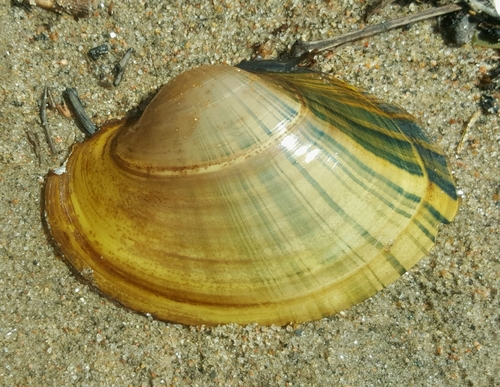
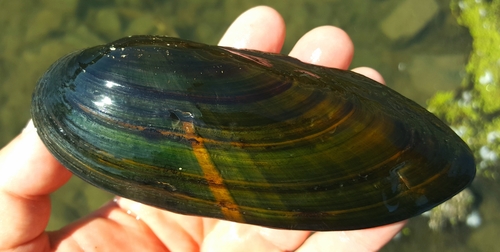
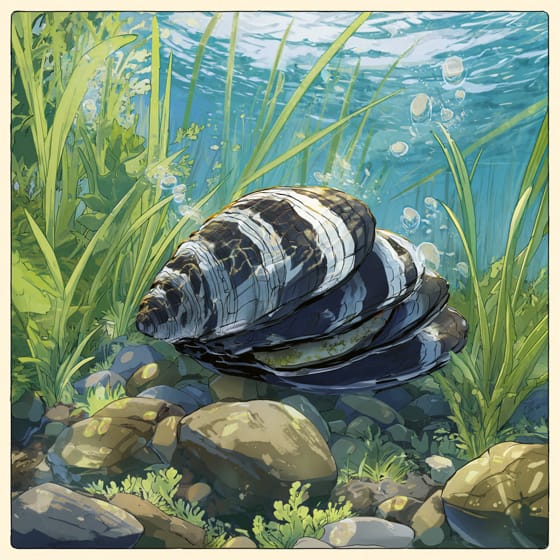
This species features a highly elongated, elliptical, and relatively smooth shell that can grow up to 20 centimeters in length. The outer shell (periostracum) is typically dark brown to completely black in adults, though juveniles may exhibit a greenish tint with faint rays. The interior lining (nacre) is remarkably glossy and varies in color from pure white to striking shades of pink or purple. When partially buried in the riverbed, usually only the dark posterior end and its siphons are visible to the naked eye.
Category
InvertebrateRarity
Common
Danger
1/5 · Very low
Snaps
1
A single adult Black Sandshell can filter up to 15 gallons of water a day, making them a crucial 'kidney' for river ecosystems.
During the late 19th and early 20th centuries, the shiny inner nacre of the Black Sandshell was harvested to manufacture pearl buttons for clothing.
Unlike most animals that travel to find new homes, this mussel relies entirely on fish to transport its offspring upstream, preventing their populations from simply washing out to sea.
Females develop a specialized, fleshy extension of their mantle that mimics a small swimming fish to attract host fish for their larvae.
Acts as a living water filter by constantly siphoning and filtering microscopic particles, greatly improving local water clarity.
Its microscopic larvae, called glochidia, temporarily attach to the gills of specific host fish to develop and eventually drop off to disperse to new habitats.
The Black Sandshell relies on filter feeding to consume microscopic plant and animal matter suspended in the water column.
Age differences: Larval glochidia absorb nutrients directly from the blood or tissues of their host fish, while mature adults are purely aquatic filter feeders.
Sander vitreus
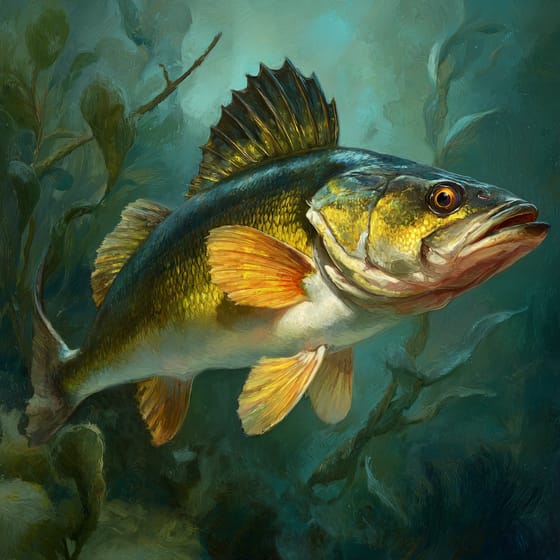
Microscopic larvae (glochidia) attach to the gills of the Walleye to complete their development into juvenile mussels.

Ondatra zibethicus
Muskrats frequently forage for mussels in shallow rivers, leaving distinct piles of empty shells called middens along the banks.
Dreissena polymorpha
Invasive Zebra mussels attach to the exposed shells of native mussels like the Black Sandshell, inhibiting their ability to feed and move.
No trait badges are assigned for this object yet.
No aliases listed yet.
Collections for this object will appear here as more themes are added.
Danger
1/5 · Very low
No special safety notes yet.
The easiest way to identify Black Sandshell is to use the Snappit nature identifier app.
10-20 cm
0.05-0.3 kg
10-25 years
The Black Sandshell relies on filter feeding to consume microscopic plant and animal matter suspended in the water column.
Typically found burrowed in the firm sand or gravel substrates of medium to large rivers with moderate to swift currents.
Filtering
10000-90000
Zoom in to split clusters and explore where this object has been snapped.
Take the discovery with you
Snap it with Snappit to identify it, learn what makes it special, and add the discovery to your collection.