Black-Staining Polypore
meripilus sumstinei
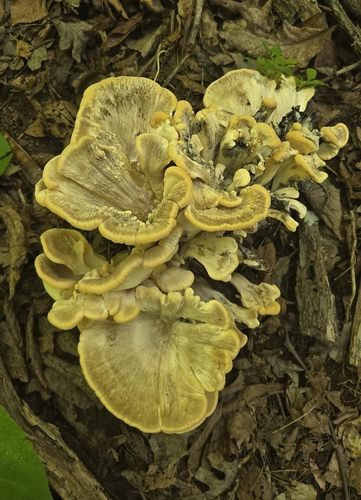
The Black-Staining Polypore is a fascinating mushroom that grows in large clusters on the ground or on wood. Its unique, dark appearance can change color when touched, making it an exciting find for young explorers!
Habitat: It lives in forests, often found near decaying wood or on the ground.
The Black-Staining Polypore has large, fan-shaped caps, often tan to reddish-brown, that merge into a massive, multi-lobed cluster at the base of trees. Its creamy white underside, made of tiny pores, quickly turns dark gray to black when bruised or cut. This distinct staining makes it easy to identify.
Category
FungiRarity
Common
Danger
1/5 · Very low
Snaps
13
Instead of gills, it has millions of tiny pore tubes!
It often grows in a beautiful rosette shape at tree bases!
Older mushrooms become very tough and woody, not soft!
This mushroom can weigh as much as a bowling ball!
Black-Staining Polypore can turn dark black when touched because of unique enzymes that react quickly with air.
Black-Staining Polypore helps decompose dead hardwood trees because it releases enzymes to break down tough wood.
Black-Staining Polypore can grow to enormous sizes, sometimes over 20 kg, that helps it release millions of spores.
Solitary animals live alone for most of their lives, only interacting with others for mating or parental care.
Camouflaged describes organisms that possess coloring or patterns that allow them to blend into their environment.
Colorful describes organisms or objects displaying a wide range of bright and distinct colors.
Describes organisms that break down dead organic material, recycling nutrients back into the ecosystem.

Forest habitats are terrestrial environments dominated by dense tree cover, supporting a high diversity of plant and animal life.
Danger
1/5 · Very low
Always ask an adult before touching or picking mushrooms.
The easiest way to identify Black-Staining Polypore is to use the Snappit nature identifier app.
10-50 cm
edible
10-90 cm
It lives in forests, often found near decaying wood or on the ground.
wood
Summer to fall
White
Zoom in to split clusters and explore where this object has been snapped.
Jun 11, 2026
ConcordPhoto attribution
(c) Ben Gruhot, some rights reserved (CC BY)
License: CC BY 4.0 ↗
Image may be shown cropped inside the card frame.

Tennessee, US
You might spot American Robin, Northern Cardinal, and Eastern Chipmunk.
View guide →

Georgia, US
You might spot Eastern Gray Squirrel, Domestic Cat, and Anole.
View guide →

Massachusetts, US
You might spot Autumn Olive and Eastern Skunk Cabbage.
View guide →

Tennessee, US
You might spot Monarch and Eastern Tiger Swallowtail.
View guide →

Alabama, US
You might spot Duck, Heavenly Bamboo, and Eastern Tiger Swallowtail.
View guide →
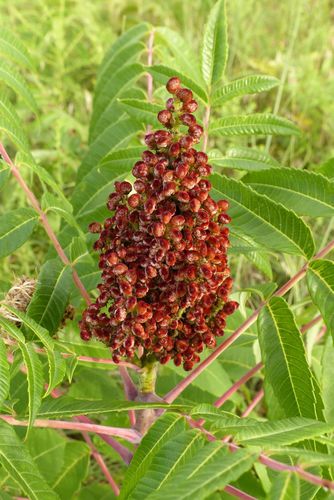
Massachusetts, US
You might spot Smooth Sumac, Brambles, and Evening Primrose Family.
View guide →
Take the discovery with you
Snap it with Snappit to identify it, learn what makes it special, and add the discovery to your collection.