

Black Swift
cypseloides niger
The Black Swift is a mysterious and captivating aerialist of the Americas, famed for its extraordinary lifestyle. Unlike most birds, it spends the vast majority of its life on the wing, foraging, drinking, and even sleeping while aloft. This elusive bird chooses highly inaccessible nesting sites, specifically vertical rock faces hidden behind or adjacent to cascading waterfalls and mist-shrouded sea cliffs. Their nests are kept constantly damp by the spray, a microclimate that deters predators but requires the chicks to withstand remarkably cold temperatures. Due to their high-altitude foraging habits and remote nesting locations, they remain one of the least understood bird species in North America.
Habitat: Found nesting on wet, shadowy vertical rock faces behind waterfalls or inside sea caves, and foraging high over mountainous canyons and forested valleys.
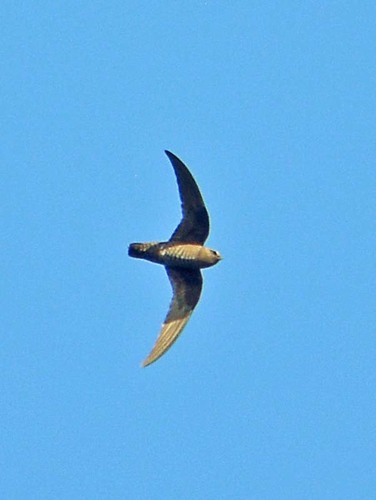
The Black Swift is the largest swift in North America, characterized by its soot-black or very dark charcoal-grey plumage. It has a slightly paler face, and its long, slender, scythe-like wings give it an elegant, anchor-like silhouette in flight. Its tail is relatively long and slightly notched, though this feature is often difficult to see unless the tail is fanned during maneuvers. Unlike swallows, which have a more undulating flight, the Black Swift flies with deep, powerful wingbeats interspersed with long, stable glides.
Category
BirdsRarity
Common
Danger
1/5 · Very low
Snaps
Be the first to snap!
Because they nest behind waterfalls, the chicks must tolerate constant freezing spray and are often damp for the entire first month of their lives.
Black Swifts lay only a single egg per nesting season, which is an exceptionally low reproductive rate for a small landbird.
Their wintering grounds were completely unknown to science until 2009, when researchers used tiny geolocators to track Colorado-breeding birds to remote areas of the Brazilian Amazon.
Exclusively builds nests on vertical cliffs in the misty spray zones behind waterfalls or inside damp sea caves to deter terrestrial predators.
Capable of staying aloft for days or even weeks at a time, sleeping while gliding at high altitudes during migration.
Nestlings can enter a state of semi-torpor, lowering their body temperature and metabolic rate to survive periods of starvation when parents cannot forage due to bad weather.
Feeds exclusively while flying, capturing aerial insects in mid-air, often targeting large swarms of flying ants and beetles at high altitudes.
Chaetura vauxi
Compete for high-altitude flying insect swarms in western North American airspace.

Formica obscuripes
Provides a vital food source during the breeding season, particularly when the winged reproductive forms swarm.

Falco peregrinus
Rarely, this fast-flying raptor will ambush Black Swifts as they forage or return to their nesting waterfalls.
No trait badges are assigned for this object yet.
No aliases listed yet.
Collections for this object will appear here as more themes are added.
Danger
1/5 · Very low
No special safety notes yet.
Compare the silhouette, bill shape, tail length, wing bars and markings around the eyes. The same small brown bird at your feeder can look quite different in breeding plumage, winter plumage or its first year. Bird Identifier: upload a photo and compare the visible details.
15-19 cm
37-43 cm
0.035-0.055 kg
5-15 years
80 km/h
Feeds exclusively while flying, capturing aerial insects in mid-air, often targeting large swarms of flying ants and beetles at high altitudes.
Found nesting on wet, shadowy vertical rock faces behind waterfalls or inside sea caves, and foraging high over mountainous canyons and forested valleys.
Zoom in to split clusters and explore where this object has been snapped.
Recent snaps will appear here as new observations are added.
Take the discovery with you
Snap it with Snappit to identify it, learn what makes it special, and add the discovery to your collection.