

Blue Jacaranda
jacaranda mimosifolia
The Blue Jacaranda (Jacaranda mimosifolia) is an internationally renowned ornamental tree famous for its breathtaking floral displays. Native to the dry forests of South America, particularly Argentina and Bolivia, this fast-growing tree has been embraced by tropical and subtropical cities worldwide. When in bloom, the tree sheds its delicate, fern-like foliage to make way for a solid canopy of vivid purple-blue flowers, creating a surreal and stunning landscape. Beyond its beauty, the Jacaranda has cultural significance in many of its adopted homelands, heralding the arrival of spring and signaling the changing of seasons.
Habitat: Found natively in dry woodlands and subtropical forest margins, though most commonly encountered lining urban streets and in city parks globally.
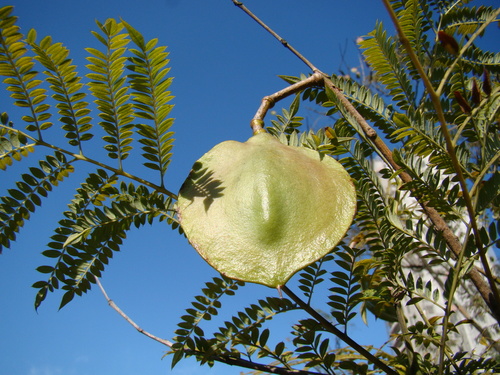
This deciduous to semi-evergreen tree typically grows between 5 and 15 meters tall, featuring a spreading, umbrella-like canopy. Its leaves are bi-pinnately compound, giving them a soft, feathery, fern-like appearance. The unmistakable focal point is its flowers: brilliant violet-blue, tubular, and bell-shaped, clustered in large panicles up to 30 centimeters long. After blooming, the tree produces distinctive round, flattened, woody seed pods that resemble castanets, each about 5 centimeters in diameter, which dry to a light brown before splitting open.
Category
PlantsRarity
Common
Danger
1/5 · Very low
Snaps
Be the first to snap!
In Australia and South Africa, it is widely referred to as the exam tree because its striking bloom coincides with the start of university final exams.
Pretoria, the administrative capital of South Africa, is affectionately known as Jacaranda City due to the roughly 70,000 jacaranda trees lining its streets.
The tree's round, woody seed pods resemble tiny castanets and are often collected to make rustic jewelry or Christmas decorations.
There is a rare white-flowered cultivar of the species called White Christmas, though the vibrant purple-blue variant remains the most famous.
The tree sheds its leaves and bursts into flower all at once, creating a dense canopy of purple that maximizes visibility to pollinators.
Its woody seed pods split open when perfectly dry, releasing papery, winged seeds that are easily carried by the wind to colonize new areas.
Highly adapted to dry seasons in its native habitat, it can survive periods of low water availability by dropping its foliage to conserve moisture.
As a photosynthetic plant, the Blue Jacaranda produces its own energy by capturing sunlight and absorbing water and minerals from the soil.
Apis mellifera
Honey bees visit the tubular flowers to collect nectar and pollen, acting as key pollinators.
Chlorostilbon lucidus
Hummingbirds feed on the abundant nectar during the massive spring blooming events.
Vachellia karroo
In introduced ranges like South Africa, jacarandas can outcompete native trees for water and space.
No trait badges are assigned for this object yet.
No aliases listed yet.
Collections for this object will appear here as more themes are added.
Danger
1/5 · Very low
No special safety notes yet.
Start with the whole plant, then compare leaf arrangement, leaf edges, stems and any flowers or fruit. Opposite leaves grow in pairs; alternate leaves come one at a time along the stem. These details tell you far more together than a single green leaf does. Plant Identifier: upload a photo and compare the visible details.
500-1500 cm
1000-5000 kg
50-200 years
As a photosynthetic plant, the Blue Jacaranda produces its own energy by capturing sunlight and absorbing water and minerals from the soil.
Found natively in dry woodlands and subtropical forest margins, though most commonly encountered lining urban streets and in city parks globally.
Zoom in to split clusters and explore where this object has been snapped.
Recent snaps will appear here as new observations are added.
Take the discovery with you
Snap it with Snappit to identify it, learn what makes it special, and add the discovery to your collection.