





low smartweed
Persicaria longiseta
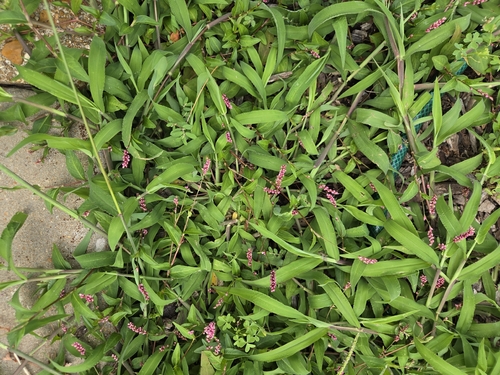
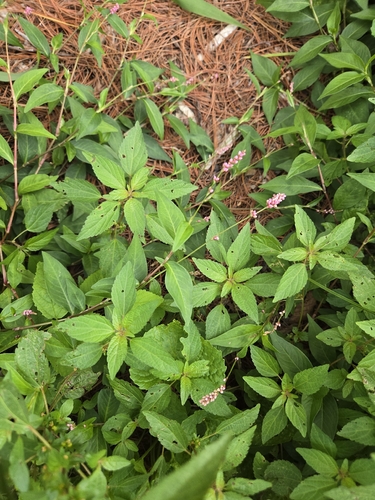
Low smartweed is a small plant that grows close to the ground. It has pretty green leaves and tiny pink flowers that attract butterflies and bees.
Habitat: Wetlands
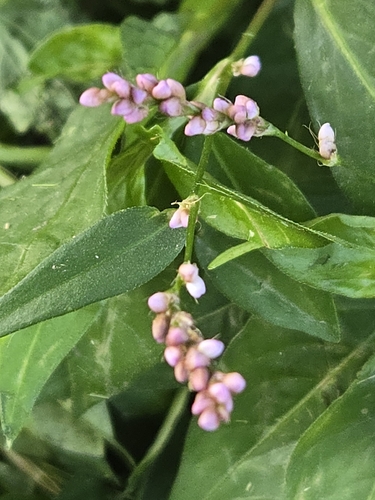
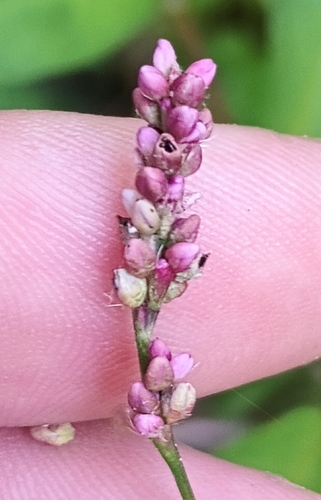
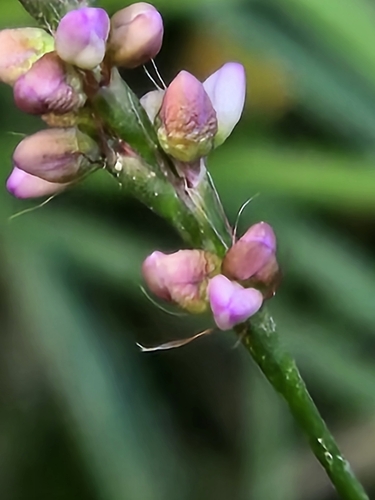
The low smartweed has slender stems, often reddish, bearing lance-shaped green leaves that may feature a dark, triangular blotch. Its tiny pinkish-white flowers grow in dense, upright, bristly spikes, resembling small bottle brushes.
Category
PlantsRarity
Common
Danger
1/5 · Very low
Snaps
40
Hundreds of tiny seeds are made by just one plant!
Its leaves actually taste spicy, like pepper, when you chew them!
This plant often has a cool purple V-shape on its leaves!
Wow! Some call its tiny, spiky flowers "pink bottle brushes"!
Low smartweed can produce a multitude of seeds rapidly, helping it quickly colonize disturbed or open areas.
This plant can tolerate very wet or even temporarily flooded soils, allowing it to thrive where other plants cannot.
It has a peppery taste due to natural compounds, which helps deter some animals from eating its leaves.
Anas platyrhynchos
Ducks love to eat its abundant seeds.
Apis mellifera
Tiny bees visit its small flowers.
Myzus persicae
Aphids sometimes feed on its sap.
Flowering plants are any plants that produce flowers as part of their reproductive cycle.
Cluster flowers are inflorescences where individual flowers are arranged closely together on a common stem.
Medicinal plants possess chemical compounds that can be used for therapeutic purposes to treat illnesses or maintain health.
Edible plants are those parts of a plant that are considered safe for human consumption.

Describes plants that are particularly attractive and beneficial to a wide range of pollinating organisms.

This habitat trait identifies species found in wetlands, which are areas of land saturated with water, either permanently or seasonally, including marshes, swamps, and bogs.

Describes organisms that transfer pollen, enabling the fertilization and reproduction of plants.
No aliases listed yet.
Danger
1/5 · Very low
Always be gentle with plants and don't eat them unless a grown-up says it's safe.
The easiest way to identify low smartweed is to use the Snappit nature identifier app.
10-60 cm
15-40 cm
0.2-0.3 cm
Summer to Fall (July-October)
Yes
None
Annual
Zoom in to split clusters and explore where this object has been snapped.
Jun 18, 2026
Missouri Botanical GardenPhoto attribution
no rights reserved
License: CC0 1.0 ↗
Image may be shown cropped inside the card frame.
Jun 18, 2026
Missouri Botanical GardenPhoto attribution
no rights reserved
License: CC0 1.0 ↗
Image may be shown cropped inside the card frame.
Jun 16, 2026
Missouri Botanical GardenPhoto attribution
no rights reserved
License: CC0 1.0 ↗
Image may be shown cropped inside the card frame.
May 17, 2026
Caldwell Street Historic DistrictPhoto attribution
(c) Raven Dandridge, some rights reserved (CC BY)
License: CC BY 4.0 ↗
Image may be shown cropped inside the card frame.
Aug 25, 2025
Owen–Putnam State ForestPhoto attribution
no rights reserved
License: CC0 1.0 ↗
Image may be shown cropped inside the card frame.

Illinois, US
You might spot Carolina Mantis and Goldenrod Soldier Beetle.
View guide →

New York, US
You might spot American Robin, Pond Slider, and Northern Cardinal.
View guide →

Arkansas, US
You might spot Pear-Shaped Puffball and American Beautyberry.
View guide →

New York, US
You might spot Rock Pigeon, American Robin, and Spotted Lanternfly.
View guide →

New Jersey, US
You might spot Eastern Gray Squirrel and Canada Goose.
View guide →

Alabama, US
You might spot Cave Salamander and Pink Lady's Slipper.
View guide →
Take the discovery with you
Snap it with Snappit to identify it, learn what makes it special, and add the discovery to your collection.







.jpg&width=800)



_001.jpg&width=800)



