





branching phacelia
Phacelia ramosissima
Branching phacelia is a lovely flower with pretty purple blooms. It grows in clusters and is often found in sunny places, bringing joy to gardens and fields.
Habitat: Grasslands
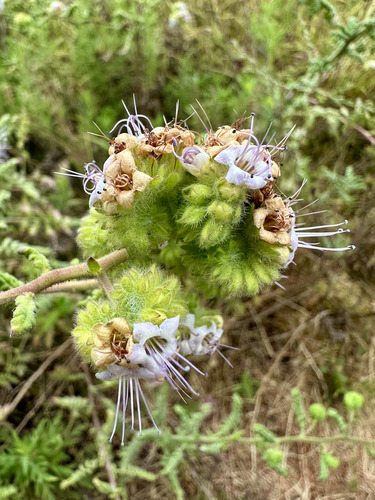
The branching phacelia has tall, often reddish, highly branched stems covered in soft, fuzzy leaves. Its small, bell-shaped flowers range from lavender to pale purple or white, forming dense, coiled clusters at the stem tips.
Category
PlantsRarity
Common
Danger
1/5 · Very low
Snaps
7
Its Greek name means "cluster," for its tightly grouped flower arrangements!
Its flowers feature elegant curled stamens, looking like tiny purple spirals!
Some Phacelia species have seeds that can sprout after a wildfire!
Tiny hairs on its leaves can help it capture moisture from morning dew!
Branching phacelia has soft, hairy leaves that help protect it from too much sun and conserve precious water in dry conditions.
It can produce many branched flower stalks, allowing it to create more seeds and attract a greater number of insect pollinators.
Branching phacelia has strong roots that help it find water and thrive in very dry, rocky soil conditions and open landscapes.
Apis mellifera
collects nectar and pollen from flowers
Bombus vosnesenskii
efficiently pollinates its small flowers
Helicoverpa zea
larvae may feed on leaves and flowers
Furry describes animals possessing a dense covering of soft hair or fur.
Describes organisms capable of converting atmospheric nitrogen into compounds usable by plants.
Ornamental plants are cultivated primarily for their aesthetic appeal, enhancing landscapes and gardens with their attractive foliage, flowers, or form.
Cluster flowers are inflorescences where individual flowers are arranged closely together on a common stem.

Spring blooming plants produce their flowers during the spring season, often signifying the end of winter and the start of new growth.

Grassland habitats are terrestrial biomes dominated by grasses and herbaceous plants, supporting a variety of grazing animals.

Describes plants that are particularly attractive and beneficial to a wide range of pollinating organisms.
No aliases listed yet.
Danger
1/5 · Very low
Always look but don't pick flowers, so everyone can enjoy them!
The easiest way to identify branching phacelia is to use the Snappit nature identifier app.
30-100 cm
30-60 cm
0.5-1.5 cm
Spring_to_late_summer
No
Mild
Perennial
Zoom in to split clusters and explore where this object has been snapped.
Jun 6, 2026
Venice Canal Historic DistrictPhoto attribution
(c) Roberto Daniel Avila, some rights reserved (CC BY)
License: CC BY 4.0 ↗
Image may be shown cropped inside the card frame.

California, US
You might spot Western Fence Lizard and California Brittlebush.
View guide →

California, US
You might spot Sunburst Anemone, Western Gull, and Giant Coreopsis.
View guide →

California, US
You might spot Canyon Sunflower, Cardinal Catchfly, and White Globe Lily.
View guide →

California, US
You might spot Western Fence Lizard and California Buckwheat.
View guide →

California, US
You might spot Western Fence Lizard, Common Side-Blotched Lizard, and Bee.
View guide →

California, US
You might spot Western Gull, Snowy Egret, and Willet.
View guide →
Take the discovery with you
Snap it with Snappit to identify it, learn what makes it special, and add the discovery to your collection.








.jpg&width=800)



_001.jpg&width=800)




