

Bristly Oxtongue
helminthotheca echioides
The Bristly Oxtongue, Helminthotheca echioides, is a robust and often overlooked member of the daisy family (Asteraceae). Native to Europe, North Africa, and parts of Asia, it has successfully colonized many temperate regions of the world, thriving in disturbed environments. Its resilience and ability to grow in challenging conditions make it a common sight, often dismissed as a mere weed. However, its distinctive bristly texture and bright yellow flowers contribute to local biodiversity, providing nectar for pollinators and serving as an indicator of nutrient-rich, disturbed soils. It's a fascinating example of a plant that flourishes by adapting to human-modified landscapes, demonstrating remarkable survival strategies.
Habitat: The Bristly Oxtongue is typically found in disturbed ground, roadsides, waste areas, cultivated fields, gardens, and along railways and hedgerows, often preferring sunny locations with nutrient-rich, well-drained soils.
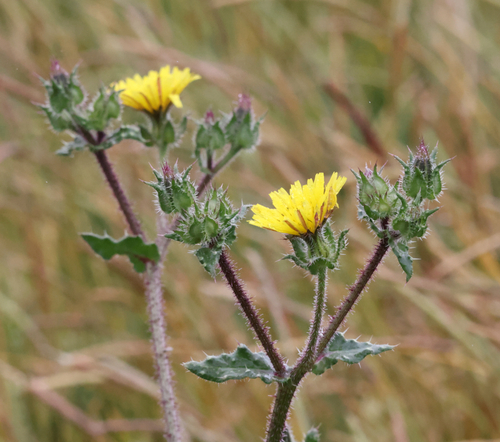
This plant is characterized by its rough, bristly texture, covering its stems and leaves. The stems are stout, erect, and often branched, growing up to 120 cm tall. Its leaves are lance-shaped to oblong, with toothed or lobed margins, and distinctively bristly, particularly on the underside. The bright yellow, dandelion-like flower heads, approximately 2-3 cm wide, are borne at the ends of the branches, typically featuring numerous ray florets. The entire plant has a somewhat rugged and untidy appearance due to its coarse hairs.
Category
PlantsRarity
Common
Danger
1/5 · Very low
Snaps
2
Bristly Oxtongue possesses a deep taproot, which helps it access water and nutrients from deeper soil layers, contributing to its resilience and drought tolerance.
Despite its bristly appearance, young leaves of Bristly Oxtongue are sometimes consumed as a wild edible, though typically cooked to soften the texture.
It can be confused with other yellow-flowered plants in the Asteraceae family, but its extremely bristly stems and leaves are a key distinguishing feature.
The common name 'oxtongue' refers to the rough, textured leaves, which are thought to resemble an ox's tongue due to their bristly surface.
This species exhibits remarkable resilience, thriving in poor, compacted, or disturbed soils where many other plants struggle, making it a successful colonizer of human-altered landscapes.
Its seeds are equipped with a pappus, a parachute-like structure of feathery bristles, allowing for effective wind dispersal over significant distances to new suitable habitats.
The coarse, stiff bristles covering its stems and leaves act as a physical defense mechanism, making the plant less palatable or accessible to many potential herbivores.
As a photosynthetic organism, Bristly Oxtongue produces its own food using sunlight, water, and carbon dioxide. It absorbs essential mineral nutrients like nitrates, phosphates, and potassium from the soil to support its growth and development.
Apis mellifera
Pollinator, sources nectar and pollen for foraging

Cornu aspersum
Herbivore, feeds on leaves and stems

Taraxacum officinale
Competitor for light, water, and soil nutrients in disturbed habitats
No trait badges are assigned for this object yet.
No aliases listed yet.
Collections for this object will appear here as more themes are added.
Danger
1/5 · Very low
No special safety notes yet.
Start with the whole plant, then compare leaf arrangement, leaf edges, stems and any flowers or fruit. Opposite leaves grow in pairs; alternate leaves come one at a time along the stem. These details tell you far more together than a single green leaf does. Plant Identifier: upload a photo and compare the visible details.
30-120 cm
1-2 years
As a photosynthetic organism, Bristly Oxtongue produces its own food using sunlight, water, and carbon dioxide. It absorbs essential mineral nutrients like nitrates, phosphates, and potassium from the soil to support its growth and development.
The Bristly Oxtongue is typically found in disturbed ground, roadsides, waste areas, cultivated fields, gardens, and along railways and hedgerows, often preferring sunny locations with nutrient-rich, well-drained soils.
Photosynthesis, Nutrient Absorption
Zoom in to split clusters and explore where this object has been snapped.

California, US
You might spot Duck, Mute Swan, and Pond Slider.
View guide →

California, US
You might spot Sunburst Anemone, Western Gull, and Giant Coreopsis.
View guide →
Take the discovery with you
Snap it with Snappit to identify it, learn what makes it special, and add the discovery to your collection.