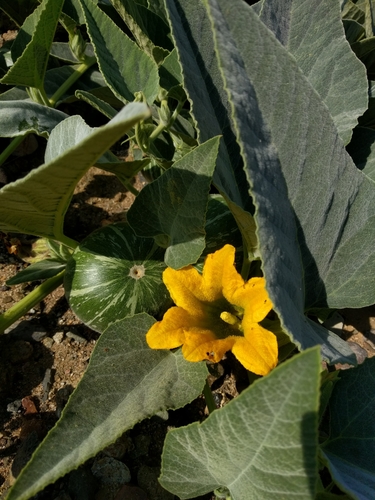


Buffalo Gourd
cucurbita foetidissima
The Buffalo Gourd (Cucurbita foetidissima), also known as the calabazilla or stinking gourd, is a hardy perennial plant native to the arid and semi-arid regions of North America. Renowned for its remarkable survival strategies, this plant thrives in harsh desert environments where few other leafy plants can cope. It is easily recognized by its sprawling, carpet-like vines and a strong, unpleasant odor released when its foliage is crushed or bruised—a clever evolutionary defense against hungry herbivores. Beneath the surface, the Buffalo Gourd develops a colossal taproot that acts as an underground water reservoir, allowing it to withstand prolonged droughts. Historically, indigenous peoples valued this plant enormously, utilizing its saponin-rich roots as soap, its seeds for nutrition, and its dried gourds as rattles, storage vessels, or utensils. Today, it remains a vital ecological component of dry grasslands, providing nourishment for specialized native pollinators.
Habitat: Found in dry, open areas such as desert grasslands, sandy soils, roadsides, and disturbed fields throughout the southwestern United States and northern Mexico.
This plant features sprawling, rough-textured vines that can spread across the ground up to 6 meters in length, covered in heart-shaped, triangular leaves that are a dusty, grayish-green color. During the summer, it produces large, bell-shaped yellow flowers that bloom in the morning and close by afternoon. The fruits are spherical, hard-shelled gourds measuring about 7 to 10 centimeters in diameter, which start with dark green and light green stripes before drying to a uniform, dull tan or yellow-brown color.
Category
PlantsRarity
Common
Danger
1/5 · Very low
Snaps
8
Despite being extremely bitter and foul-smelling to humans, the seeds are highly nutritious and were roasted and eaten by Native American tribes.
Indigenous peoples crushed the roots of this plant in water to create a soapy lather used for washing clothes and treating skin conditions.
The giant taproot of an established Buffalo Gourd can grow to be as heavy as an adult human, sometimes weighing up to 90 kilograms.
The plant grows a massive, tuberous taproot that can weigh over 50 kilograms, storing immense amounts of water and starch to survive extreme desert droughts.
Its leaves and stems produce bitter compounds called cucurbitacins and emit a foul, musky odor when damaged, discouraging herbivores from eating them.
Following brief desert rainstorms, the vine can grow at an astonishing rate, rapidly spreading its leaves to maximize photosynthesis while moisture is available.
As a photoautotroph, the Buffalo Gourd produces its own energy via photosynthesis, utilizing sunlight, carbon dioxide, and water drawn through its massive taproot.
Peponapis pruinosa
Highly specialized squash bees act as the primary pollinators of the Buffalo Gourd's morning-blooming flowers.
Acalymma vittatum
The larvae of this beetle feed on the roots, while the adults consume the leaves, stems, and blossoms of the plant.
No trait badges are assigned for this object yet.
No aliases listed yet.
Collections for this object will appear here as more themes are added.
Danger
1/5 · Very low
No special safety notes yet.
The easiest way to identify Buffalo Gourd is to use the Snappit nature identifier app.
100-600 cm
5-75 kg
10-40 years
As a photoautotroph, the Buffalo Gourd produces its own energy via photosynthesis, utilizing sunlight, carbon dioxide, and water drawn through its massive taproot.
Found in dry, open areas such as desert grasslands, sandy soils, roadsides, and disturbed fields throughout the southwestern United States and northern Mexico.
Zoom in to split clusters and explore where this object has been snapped.

California, US
You might spot Western Fence Lizard and California Brittlebush.
View guide →

New Mexico, US
You might spot Tree Cholla, Colorado Pinyon, and House Finch.
View guide →

New Mexico, US
You might spot Pronghorn, Great-Tailed Grackle, and Redstem Stork's-Bill.
View guide →

California, US
You might spot Western Fence Lizard, Duck, and California Brittlebush.
View guide →

California, US
You might spot Sunburst Anemone, Ochre Sea Star, and Striped Shore Crab.
View guide →

Oklahoma, US
You might spot Hoary Vervain, Buffalo Gourd, and Pond Slider.
View guide →
Take the discovery with you
Snap it with Snappit to identify it, learn what makes it special, and add the discovery to your collection.











.jpg&width=800)



_001.jpg&width=800)




