




Burmese Python
Python bivittatus
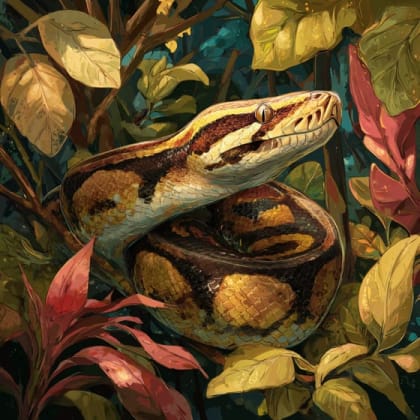
The Burmese Python is a big snake with beautiful patterns. They are great at climbing trees and like to bask in the sun!
Habitat: Tropical forests and grasslands
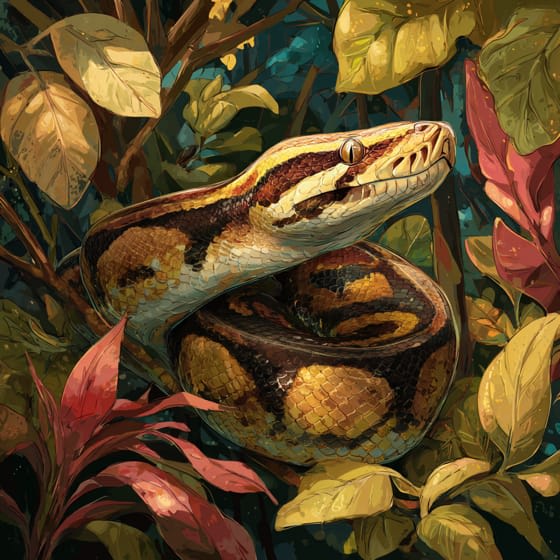
The Burmese Python is a large, heavy-bodied snake with striking patterns. It has dark, irregular blotches outlined in black, set against a lighter tan or yellowish background. A distinct dark arrow shape often marks its head.
Category
ReptilesRarity
Common
Danger
4/5 · High
Snaps
3
A mother python wraps around her eggs and shivers to keep them warm!
Burmese Pythons are excellent swimmers, moving gracefully through water!
Their patterned skin makes them masters of disguise, blending perfectly into their habitat!
This amazing snake can go months without eating after just one huge meal!
Burmese Python can constrict prey using its powerful body because this helps them suffocate meals before swallowing.
Burmese Python has special heat-sensing pits on its face that help them find warm-blooded prey, even in total darkness.
Burmese Python can unhinge its jaw because this allows them to swallow animals much wider than their own head.
Burmese Python can hold its breath for nearly 30 minutes, which helps them ambush prey or escape danger underwater.
This giant snake is a powerful carnivore that eats mammals and birds whole!
Age differences: Young pythons eat smaller prey like rodents, while adults can take on much larger animals.
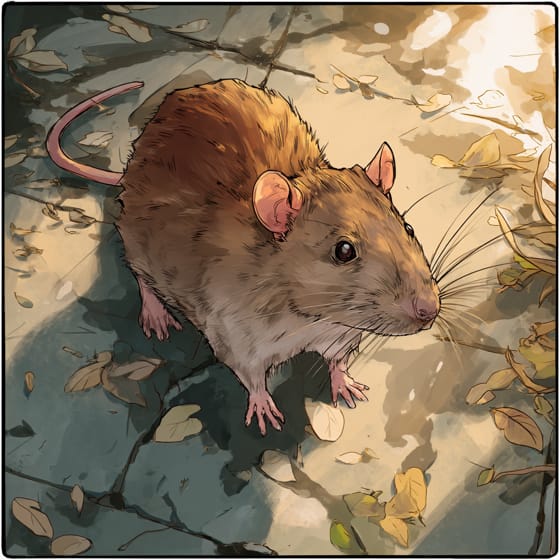
Rattus norvegicus
A common prey item.
Cervus unicolor
A large prey item for adults.
Solitary animals live alone for most of their lives, only interacting with others for mating or parental care.
Arboreal animals live primarily in trees, utilizing them for shelter, food, and protection from predators.
Thermoregulating organisms maintain a stable internal body temperature despite fluctuations in the external environment.
An ambush predator hunts by patiently waiting and concealing itself, then launching a sudden attack when unsuspecting prey comes within range.

This trait signifies organisms belonging to a very old evolutionary group with ancestors dating back millions of years.

This habitat trait refers to species found in tropical rainforests, characterized by high annual rainfall, high biodiversity, and dense tree cover.

This trait identifies organisms whose diet consists entirely or primarily of animal tissue.

Nocturnal animals are primarily active during the nighttime hours, typically resting or sleeping during the day.
Danger
4/5 · High
Look but don’t touch. Keep a safe distance and wash hands after exploring.
The easiest way to identify Burmese Python is to use the Snappit nature identifier app.
370-760 cm
50-180 kg
15-25 years
2 km/h
This giant snake is a powerful carnivore that eats mammals and birds whole!
8 km/h
Tropical forests and grasslands
Zoom in to split clusters and explore where this object has been snapped.

Illinois, US
You might spot Southern White Rhinoceros and Reticulated Giraffe.
View guide →
Virginia, US
You might spot Snow Leopard, Red Panda, and Canis Lupus Rufus.
View guide →

Florida, US
You might spot Peters's Rock Agama, Common Myna, and Brown Anole.
View guide →

US
You might spot Great Barracuda, Gray Snapper, and Red Mangrove.
View guide →

Nevada, US
You might spot Komodo Dragon, Sand Tiger Shark, and Sea Turtle.
View guide →
Take the discovery with you
Snap it with Snappit to identify it, learn what makes it special, and add the discovery to your collection.