
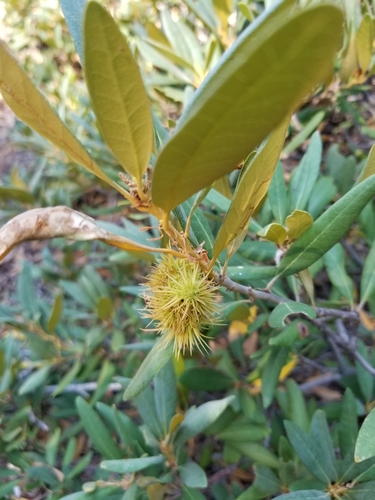


Bush Chinquapin
chrysolepis sempervirens
The Bush Chinquapin (Chrysolepis sempervirens) is a resilient, evergreen shrub native to the montane regions of the western United States, particularly California's Sierra Nevada and Cascade ranges. Clinging to rocky slopes and thriving in dry chaparral, this tough member of the beech family (Fagaceae) is beautifully adapted to high-altitude living. It plays a vital role in stabilizing slopes and providing cover for alpine wildlife in areas where few other woody plants can survive. What makes the Bush Chinquapin particularly remarkable is its vibrant color contrast and its protective, golden-spiced chestnut-like burs. During the summer, its branches burst with golden-yellow catkins that emit a strong, sweet fragrance to attract pollinators, while its golden-furred undersides shimmer in the mountain breeze.
Habitat: Found on dry, rocky slopes, ridges, and open coniferous forests in montane and subalpine zones.
This low-growing, spreading evergreen shrub typically reaches heights of 1 to 2.5 meters. It is easily identified by its leathery, oblong leaves, which are dark, glossy green on top and covered in a distinctive, powdery golden-yellow or rust-colored layer underneath. In summer, it produces long, upright catkins of tiny, pale yellow flowers. The most striking visual cue is the fruit: a highly conspicuous, spiny, golden-brown bur resembling a sea urchin, which matures to reveal one or two small, triangular, edible nuts.
Category
PlantsRarity
Common
Danger
1/5 · Very low
Snaps
Be the first to snap!
Despite being closely related to oaks and chestnuts, its genus Chrysolepis contains only two species, both of which are native exclusively to western North America.
Its specific epithet 'sempervirens' is Latin for 'always green,' highlighting its ability to retain its vibrant leaves even through harsh, freezing mountain winters.
The nuts inside the formidable prickly burs are completely edible and possess a sweet, chestnut-like flavor, once prized by Native American tribes as a valuable food source.
The underside of the leaves is coated with dense, golden scales that reflect intense high-altitude sunlight and reduce water loss through transpiration.
Following wildfires, this shrub can rapidly regenerate from a stout, underground burl, allowing it to quickly reclaim its place in chaparral ecosystems.
Its seeds are protected inside a densely spine-covered husk, or bur, which deters many seed predators until the nuts are fully mature.
As a photoautotrophic plant, the Bush Chinquapin produces its own organic energy using sunlight, water, and carbon dioxide through the process of photosynthesis.
Tamiasciurus douglasii
Harvests and feeds on the highly nutritious nuts from the spiny burs.
Callospermophilus lateralis
Caches the edible nuts in the soil, helping to disperse and plant the seeds.
No trait badges are assigned for this object yet.
No aliases listed yet.
Collections for this object will appear here as more themes are added.
Danger
1/5 · Very low
No special safety notes yet.
Start with the whole plant, then compare leaf arrangement, leaf edges, stems and any flowers or fruit. Opposite leaves grow in pairs; alternate leaves come one at a time along the stem. These details tell you far more together than a single green leaf does. Plant Identifier: upload a photo and compare the visible details.
100+ cm
As a photoautotrophic plant, the Bush Chinquapin produces its own organic energy using sunlight, water, and carbon dioxide through the process of photosynthesis.
Found on dry, rocky slopes, ridges, and open coniferous forests in montane and subalpine zones.
Zoom in to split clusters and explore where this object has been snapped.
Recent snaps will appear here as new observations are added.

California, US
You might spot Sequoia, California Incense-Cedar, and White Fir.
View guide →
California, US
You might spot Sequoia, Whiskerbrush, and Black Bear.
View guide →

California, US
You might spot Sequoia, Mule Deer, and Black Bear.
View guide →

California, US
You might spot Sequoia, Mule Deer, and Black Bear.
View guide →

California, US
You might spot Sequoia, Mule Deer, and Yellow-Bellied Marmot.
View guide →

California, US
You might spot Sequoia, Thimbleberry, and Pacific Dogwood.
View guide →
Take the discovery with you
Snap it with Snappit to identify it, learn what makes it special, and add the discovery to your collection.

















