




Bush Vetch
Vicia sepium
Bush Vetch is a climbing plant with pretty purple flowers. It grows in fields and along roadsides, making the world a little brighter with its colors.
Habitat: Grasslands
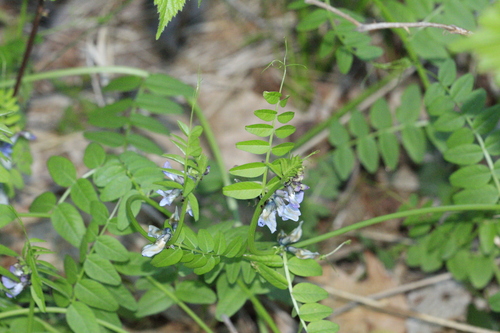
The Bush Vetch is a scrambling plant with delicate purple-blue, pea-like flowers that grow in small clusters. It has distinctive green leaves made of several pairs of oval leaflets, ending in branched tendrils that help it climb. Its overall appearance is often found trailing through other vegetation.
Category
PlantsRarity
Common
Danger
1/5 · Very low
Snaps
2
Before modern farming, Bush Vetch was sometimes grown in fields to help feed farm animals!
Even its name, 'Vetch,' comes from an old word meaning 'to bind' or 'twist,' just like its climbing stems!
Its seed pods burst open with a snap, flinging tiny seeds far away to grow new plants!
This plant is a 'soil superhero,' adding special goodness that helps other plants grow big and strong!
Bush Vetch has tiny coiled tendrils that help it grip other plants, allowing it to climb upwards to reach more sunlight.
Bush Vetch can pull nitrogen from the air into its roots, enriching the soil and helping other plants grow stronger.
Bush Vetch has seed pods that burst open when dry, flinging seeds away to colonize new areas.
Bombus terrestris
Feeds on nectar, aiding reproduction.
Apis mellifera
Collects pollen and nectar for its colony.
Aphis fabae
Feeds on its sap, potentially weakening it.
Rhizobium leguminosarum
Forms nodules for nitrogen fixation.
Climbing or vine plants are characterized by a growth habit that allows them to ascend upwards by twining, tendrils, or adhesive roots.
Flowering plants are any plants that produce flowers as part of their reproductive cycle.
Describes organisms capable of converting atmospheric nitrogen into compounds usable by plants.
Edible plants are those parts of a plant that are considered safe for human consumption.

Grassland habitats are terrestrial biomes dominated by grasses and herbaceous plants, supporting a variety of grazing animals.

Describes plants that are particularly attractive and beneficial to a wide range of pollinating organisms.

Rapid growing plants exhibit accelerated growth rates, quickly increasing in size and biomass within a short period.

Describes a species whose presence and role have a disproportionately large effect on its environment.
No aliases listed yet.
Danger
1/5 · Very low
Always look but don't touch wild plants without asking an adult.
The easiest way to identify Bush Vetch is to use the Snappit nature identifier app.
30-100 cm
20-80 cm
1-1.5 cm
Late spring to late summer
Yes
None
Perennial
Zoom in to split clusters and explore where this object has been snapped.
May 30, 2026
Rockport Historic DistrictPhoto attribution
no rights reserved
License: CC0 1.0 ↗
Image may be shown cropped inside the card frame.
.jpg)
Ústí nad Labem Region, CZ
You might spot Bears, South American Tapir, and Macaques.
View guide →

Maine, US
You might spot Black Tar Spot, Norway Maple, and Himalayan Balsam.
View guide →
Take the discovery with you
Snap it with Snappit to identify it, learn what makes it special, and add the discovery to your collection.








.jpg&width=800)



_001.jpg&width=800)



