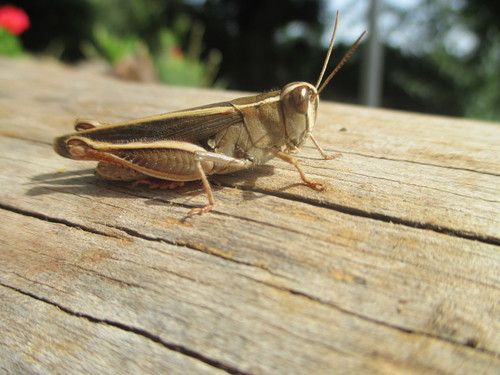


Calliptamus Plebeius
calliptamus plebeius
The Calliptamus Plebeius, a member of the grasshopper family Acrididae, is a common and fascinating insect primarily found across the Mediterranean basin. These robust orthopterans are well-adapted to dry, sunny environments, showcasing remarkable camouflage that allows them to blend seamlessly with their surroundings. Often overlooked due to their unassuming appearance, they play a crucial role in grassland ecosystems as primary consumers, converting plant matter into energy for higher trophic levels. Their life cycle, from egg to nymph to adult, unfolds rapidly during the warmer months, making them a vibrant component of summer landscapes.
Habitat: Found in dry, open habitats such as Mediterranean scrubland, garrigue, stony grasslands, fallow fields, and sunny slopes with sparse vegetation.
Calliptamus Plebeius is a medium-sized grasshopper, typically ranging from 1.5 to 3.5 cm in length, with females being noticeably larger than males. Its coloration is highly variable, usually exhibiting shades of grey, brown, or reddish-brown, often mottled, providing excellent camouflage against dry vegetation and soil. A key identifier is its characteristic 'slant-faced' profile. The hind tibiae are frequently a distinctive reddish or orange hue. Its forewings (tegmina) are well-developed and often extend beyond the abdomen, while the hindwings are usually transparent or faintly colored.
Category
InsectsRarity
Common
Danger
1/5 · Very low
Snaps
Be the first to snap!
Like many grasshoppers, Calliptamus Plebeius can produce a
Its variable cryptic coloration allows it to blend perfectly with its arid and semi-arid surroundings, making it incredibly difficult for predators to spot. This helps it avoid detection from birds and lizards.
Equipped with strong, muscular hind legs, Calliptamus Plebeius can execute impressive jumps, propelling itself quickly away from perceived threats. This is its primary escape mechanism when disturbed.
Males produce characteristic sounds by rubbing their hind legs against their forewings, a process known as stridulation, primarily used to attract mates and communicate within their species.
Calliptamus Plebeius is a polyphagous herbivore, feeding on a wide variety of herbaceous plants and grasses. It grazes on the leaves and stems of available vegetation.

Merops apiaster
A common predator that feeds on various insects, including grasshoppers, especially during breeding season.

Lacerta bilineata
Preys on a wide range of insects found in arid environments.

Meloe proscarabaeus
Larvae of certain blister beetles are parasitic on grasshopper egg pods, consuming the eggs.

Araneus diadematus
A broad-spectrum predator that captures many insects, including grasshoppers, in its webs.
No trait badges are assigned for this object yet.
No aliases listed yet.
Collections for this object will appear here as more themes are added.
Danger
1/5 · Very low
No special safety notes yet.
Look for six legs, antennae, three body sections and the shape of the wings. Beetles have hardened front wings; flies have just one working pair. Tiny insects may need a close view before their group is clear. Insect Identifier: upload a photo and compare the visible details.
1-3 cm
3-6 cm
0.001-0.005 kg
0 years
Calliptamus Plebeius is a polyphagous herbivore, feeding on a wide variety of herbaceous plants and grasses. It grazes on the leaves and stems of available vegetation.
Found in dry, open habitats such as Mediterranean scrubland, garrigue, stony grasslands, fallow fields, and sunny slopes with sparse vegetation.
Foraging
Zoom in to split clusters and explore where this object has been snapped.
Recent snaps will appear here as new observations are added.
Take the discovery with you
Snap it with Snappit to identify it, learn what makes it special, and add the discovery to your collection.