

Canary Herb-Robert
geranium reuteri
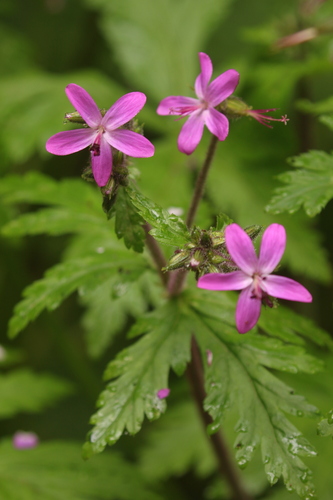
The Canary Herb-Robert (Geranium reuteri) is a delicate, endemic herbaceous plant native to the lush, ancient laurel forests (laurisilva) of the Canary Islands. Evolving in the humid, shaded understories of these unique volcanic islands, this short-lived perennial or biennial is a striking example of Macaronesian island flora. Much like its widespread European relative, the common Herb-Robert, it features intricately divided, fern-like foliage that exudes a distinctive, pungent aroma when crushed or brushed against. The Canary Herb-Robert graces the forest floor with delightful, five-petaled pink flowers adorned with deeper pink or reddish veins, blooming profusely during the moister spring months. What truly makes this plant stand out is its dynamic response to environmental stress; its typically bright green leaves often flush with brilliant shades of red when exposed to strong sunlight or drought conditions, adding a vivid splash of color to the often-monochrome forest undergrowth.
Habitat: Found primarily in the humid, deeply shaded understories and margins of the ancient laurel forests (laurisilva) endemic to the Canary Islands.
This herbaceous plant features deeply lobed, highly dissected leaves that give it a feathery, fern-like appearance. The foliage is bright green but frequently develops striking crimson or reddish tinges, especially along the stems and leaf margins when exposed to bright light or dry conditions. Its delicate, symmetrical flowers measure about 1.5 to 2 centimeters across, consisting of five rounded pink petals intricately marked with darker reddish-pink veins. Following flowering, it produces a distinctive, elongated, beak-like seed pod characteristic of the Geranium family.
Category
PlantsRarity
Common
Danger
1/5 · Very low
Snaps
Be the first to snap!
Because it thrives in the unique cloud forests of the Canary Islands, it captures moisture directly from the fog that rolls through the canopy.
Its strong, musky scent has been compared to burning tires or bitter herbs, a chemical mechanism that repels many would-be predators.
Like many plants in the Geraniaceae family, its seed pods are shaped remarkably like the bill of a crane, giving the family its common name 'cranesbills'.
The species name 'reuteri' honors the 19th-century Swiss botanist Georges Francois Reuter, who extensively studied Mediterranean flora.
When the beak-like seed pods dry out, they act like tiny catapults, explosively ejecting seeds several meters away from the parent plant to reduce competition.
The plant produces red pigments called anthocyanins in its leaves and stems to act as sunscreen and protect cellular structures during intense sunlight or drought.
Glandular hairs on the leaves and stems release a strong, distinctive odor when bruised or crushed, helping to deter herbivorous insects and grazing animals.
As a photosynthetic plant, it generates its own energy using sunlight while drawing essential moisture and minerals from the rich volcanic soils of the laurisilva.
Bombus terrestris
Visits the plant's pink flowers to collect nectar and pollen, acting as a primary pollinator.

Oryctolagus cuniculus
Introduced rabbits occasionally graze on the foliage despite its aromatic defenses.
Cacyreus marshalli
This invasive butterfly lays its eggs on Geranium species, and its caterpillars feed on the plant's flower buds and leaves.
No trait badges are assigned for this object yet.
No aliases listed yet.
Collections for this object will appear here as more themes are added.
Danger
1/5 · Very low
No special safety notes yet.
Start with the whole plant, then compare leaf arrangement, leaf edges, stems and any flowers or fruit. Opposite leaves grow in pairs; alternate leaves come one at a time along the stem. These details tell you far more together than a single green leaf does. Plant Identifier: upload a photo and compare the visible details.
20-60 cm
1-3 years
As a photosynthetic plant, it generates its own energy using sunlight while drawing essential moisture and minerals from the rich volcanic soils of the laurisilva.
Found primarily in the humid, deeply shaded understories and margins of the ancient laurel forests (laurisilva) endemic to the Canary Islands.
Photosynthesis
Zoom in to split clusters and explore where this object has been snapped.
Recent snaps will appear here as new observations are added.
Take the discovery with you
Snap it with Snappit to identify it, learn what makes it special, and add the discovery to your collection.