





Chinese Holly
ilex cornuta
Chinese Holly is a beautiful plant with shiny green leaves and bright red berries! It's a great addition to gardens and can attract birds looking for food.
Habitat: Chinese Holly is commonly found in gardens and parks, often in temperate climates.
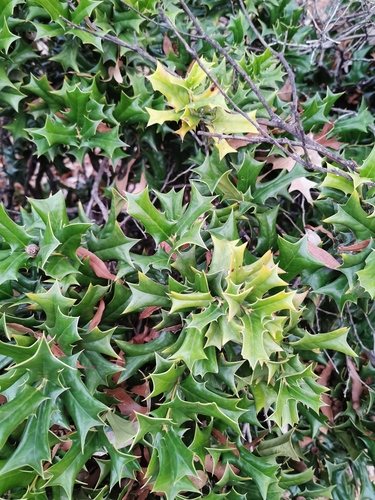
The Chinese Holly has striking dark green leaves that are often rectangular and extremely glossy, featuring sharp, spiky edges. Its most distinctive feature is the abundance of bright, cherry-red berries that ripen in fall and remain vibrant throughout winter.
Category
PlantsRarity
Common
Danger
1/5 · Very low
Snaps
8
It can live for many decades, growing into a grand old bush or tree!
Its glossy leaves are so shiny they almost look fake!
Some Chinese Holly plants only produce male or female flowers, needing a partner to make berries!
The scientific name 'cornuta' means 'horned,' like its pointy leaves!
Chinese Holly has extra-sharp leaf spines that deter hungry animals from munching on its foliage, keeping it safe.
Its bright red berries persist through winter, offering a vital food source for birds when other foods are scarce.
Chinese Holly stays green all year, allowing it to photosynthesize even in colder months when other plants lose leaves.
Apis mellifera
collects nectar and pollen
Turdus mandarinus
eats its winter berries
%2C_Parc_de_Woluw%C3%A9%2C_Brussels_(13042792905).jpg&width=800)
Parus major
nests in its dense branches
Arboreal animals live primarily in trees, utilizing them for shelter, food, and protection from predators.
Colorful describes organisms or objects displaying a wide range of bright and distinct colors.
This trait characterizes organisms whose diet consists entirely or primarily of plant material.
Forest habitats are terrestrial environments dominated by dense tree cover, supporting a high diversity of plant and animal life.

Describes organisms that transfer pollen, enabling the fertilization and reproduction of plants.
Danger
1/5 · Very low
No special safety notes yet.
The easiest way to identify Chinese Holly is to use the Snappit nature identifier app.
300-800 cm
200-400 cm
0.5-1 cm
Spring
No
mild
Perennial
Zoom in to split clusters and explore where this object has been snapped.
Dec 27, 2025
Vanderbilt UniversityPhoto attribution
(c) Y. Liu, some rights reserved (CC BY)
License: CC BY 4.0 ↗
Image may be shown cropped inside the card frame.

Alabama, US
You might spot Eastern Box Turtle, Carolina Wren, and Field Sparrow.
View guide →

Tennessee, US
You might spot Eastern Gray Squirrel and American Robin.
View guide →

Virginia, US
You might spot Eastern Gray Squirrel, Northern Cardinal, and Red Fox.
View guide →

Alabama, US
You might spot Duck, White Clover, and American Coot.
View guide →

Georgia, US
You might spot Pond Slider, Snapping Turtle, and American Beautyberry.
View guide →

Alabama, US
You might spot Canada Goose, Lesser Scaup, and Duck.
View guide →
Take the discovery with you
Snap it with Snappit to identify it, learn what makes it special, and add the discovery to your collection.








.jpg&width=800)



_001.jpg&width=800)




