_Spooner_%26_Bridge_200107.jpg&width=800)





Chip Cherries
leratiomyces ceres
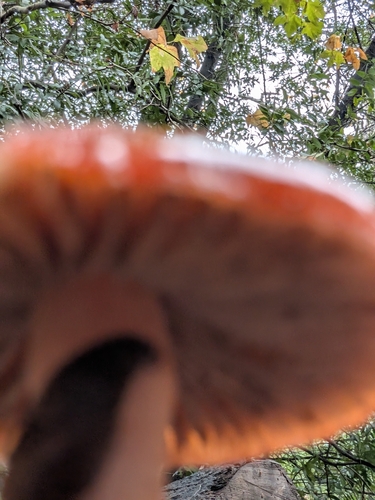
Chip Cherries are colorful mushrooms that look like tiny cherries growing on trees! They are fun to find during nature walks, especially in the forest.
Habitat: Chip Cherries thrive in damp, wooded areas, often found at the base of trees.
The Chip Cherries has striking bright red to orange-red caps, often with a paler, yellowish margin. Its small, round caps sit atop a slender white or pale yellowish stem, sometimes growing in scattered groups. This mushroom truly stands out against its woody backdrop.
Category
FungiRarity
Common
Danger
1/5 · Very low
Snaps
2
If you crush them, they can sometimes smell faintly like radishes!
Its scientific name, *ceres*, refers to the Roman goddess of agriculture!
The cap can change from deep red to orange as it gets older!
These tiny mushrooms often pop up in gardens using wood chip mulch!
Chip Cherries has bright red caps that act as a visual warning, helping to deter animals that might try to eat them.
Chip Cherries can break down dead wood into useful soil nutrients, helping to clear debris and enrich the forest floor.
Chip Cherries releases millions of tiny spores that float on the wind, helping new mushrooms grow far away.
Solitary animals live alone for most of their lives, only interacting with others for mating or parental care.
Arboreal animals live primarily in trees, utilizing them for shelter, food, and protection from predators.
Colorful describes organisms or objects displaying a wide range of bright and distinct colors.
Describes organisms that break down dead organic material, recycling nutrients back into the ecosystem.

Forest habitats are terrestrial environments dominated by dense tree cover, supporting a high diversity of plant and animal life.
Danger
1/5 · Very low
Do not touch or eat mushrooms without an adult's help.
The easiest way to identify Chip Cherries is to use the Snappit nature identifier app.
2-6 cm
inedible
1-4 cm
Chip Cherries thrive in damp, wooded areas, often found at the base of trees.
wood
Summer to Fall
Purple-brown
Zoom in to split clusters and explore where this object has been snapped.
Dec 26, 2025
Santa Barbara Botanic GardenPhoto attribution
(c) Aaron Kreisberg, some rights reserved (CC BY)
License: CC BY 4.0 ↗
Image may be shown cropped inside the card frame.

Washington, US
You might spot Rock Pigeon, American Crow, and Olympic Gull.
View guide →

California, US
You might spot Red-Cage Fungus and Black-Bellied Slender Salamander.
View guide →

Washington, US
You might spot Canada Goose, Daisy, and Duck.
View guide →
Take the discovery with you
Snap it with Snappit to identify it, learn what makes it special, and add the discovery to your collection.





-left_01.jpg&width=800)