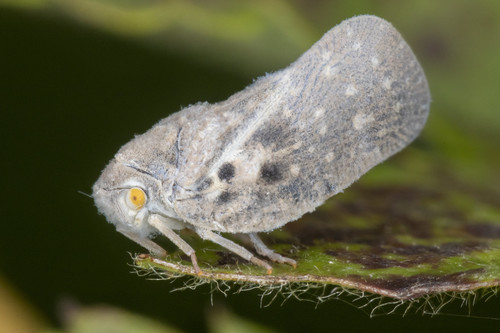


Citrus Flatid Planthopper
metcalfa pruinosa
The Citrus Flatid Planthopper (Metcalfa pruinosa) is a fascinating insect native to North America that has successfully colonized parts of Europe and Asia. Known for its moth-like appearance, this tiny sap-sucking bug is often noticed due to the white, fluffy, waxy secretions left behind by its nymphs. While they feed on a vast array of host plants, including citrus fruits, grapes, and various ornamental trees, they are particularly famous in the apiculture world. In areas where they have been introduced, honeybees eagerly harvest the sweet honeydew excreted by these planthoppers, producing a unique and highly valued dark honey. Despite their potential to become agricultural pests in high densities, they are a marvel of micro-fauna, demonstrating complex relationships with both plants and other insects.
Habitat: Found in a wide range of terrestrial habitats, including deciduous forests, agricultural orchards, vineyards, and suburban gardens with abundant woody host plants.
Adult Citrus Flatid Planthoppers are about 5 to 8 mm in length and hold their broad, wedge-shaped wings vertically over their bodies in a tent-like fashion, making them look like small moths. They are typically bluish-gray to purplish-brown in color, covered with a fine, powdery white wax that gives them a frosted appearance. Their eyes are prominent and often have a striking orange or yellow hue. In contrast, the flightless nymphs are easily identified by the long, dramatic tufts of white, cottony wax filaments trailing from their abdomens, which they use for camouflage and protection.
Category
InsectsRarity
Common
Danger
1/5 · Very low
Snaps
3
European beekeepers value this species because honey bees harvest its honeydew to create a prized, dark-colored 'Metcalfa honey' with a unique malty flavor.
In Europe, where it was accidentally introduced in the late 1970s, it has rapidly spread to over 20 countries, feeding on more than 300 different plant species.
The white, cottony fluff secreted by the nymphs is actually a hydrophobic wax that prevents them from drowning in their own sticky honeydew.
Nymphs secrete a white, hydrophobic wax that covers their bodies, protecting them from desiccation, fungal infections, and potential predators.
Using powerful hind legs, both nymphs and adults can launch themselves rapidly into the air to escape immediate threats.
They process vast quantities of plant sap, excreting a sugary honeydew that fosters ecological interactions with ants and honeybees.
Feeds exclusively on the phloem sap of a wide variety of woody and herbaceous plants, extracting nutrients while excreting excess sugars.
Neodryinus typhlocybae
The parasitoid wasp Neodryinus typhlocybae lays its eggs in the planthopper nymphs, acting as a key biological control agent.
Vitis vinifera
Serves as a major host plant where Metcalfa pruinosa feeds on sap and can cause minor agricultural damage.
Apis mellifera
Honey bees collect the sugary honeydew excreted by the planthoppers to produce a dark, mineral-rich forest honey.
No trait badges are assigned for this object yet.
No aliases listed yet.
Collections for this object will appear here as more themes are added.
Danger
1/5 · Very low
No special safety notes yet.
The easiest way to identify Citrus Flatid Planthopper is to use the Snappit nature identifier app.
0+ cm
1+ cm
0.00001+ kg
0+ years
Feeds exclusively on the phloem sap of a wide variety of woody and herbaceous plants, extracting nutrients while excreting excess sugars.
Found in a wide range of terrestrial habitats, including deciduous forests, agricultural orchards, vineyards, and suburban gardens with abundant woody host plants.
Foraging
Zoom in to split clusters and explore where this object has been snapped.

Georgia, US
You might spot Brown Anole, Anole, and Gulf Fritillary.
View guide →

Virginia, US
You might spot Asian Lady Beetle, Spotted Lanternfly, and Christmas Fern.
View guide →

Delaware, US
You might spot Red Fox and Citrus Flatid Planthopper.
View guide →

Delaware, US
You might spot Red Fox, Citrus Flatid Planthopper, and American Toad.
View guide →
Take the discovery with you
Snap it with Snappit to identify it, learn what makes it special, and add the discovery to your collection.












.jpg&width=800)




