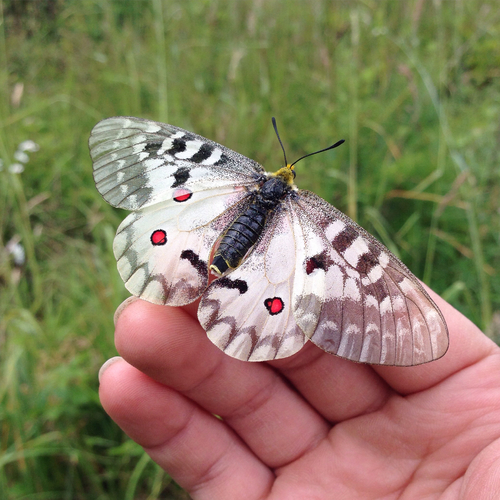


Clodius Parnassian
parnassius clodius
The Clodius Parnassian is an elegant, high-altitude butterfly belonging to the swallowtail family. Found in the moist montane meadows and cool forest edges of western North America, this resilient insect is celebrated for its slow, floating flight and its ability to thrive in chilly, alpine environments where few other butterflies can survive. Unlike typical swallowtails, it lacks the characteristic tail extensions, boasting a more rounded wing shape instead.
Habitat: Found in moist montane and subalpine meadows, forest openings, and streamsides in western North America.
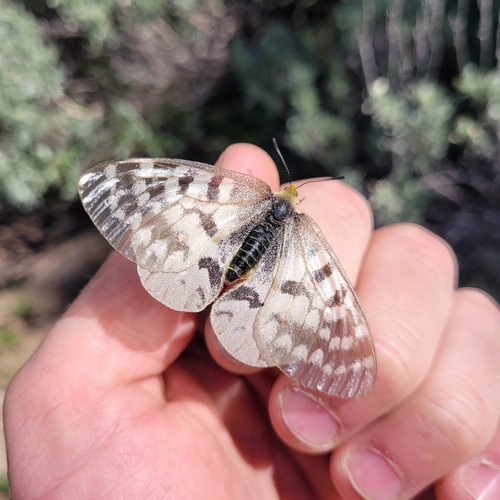
With a wingspan ranging from 5 to 7 centimeters, the Clodius Parnassian features beautiful, semi-translucent white wings that look almost like delicate parchment. The forewings are marked with dark gray or black spots and charcoal-toned outer margins, while the hindwings display striking red or orange spots ringed with black. Its body is notably dark and covered in fine, insulating hair-like scales, which help it retain warmth in cold mountain air.
Category
InsectsRarity
Common
Danger
1/5 · Very low
Snaps
1
The translucent areas on their wings are actually bald spots that lack the typical overlapping scales found on other butterflies.
Their eggs are laid directly on the ground or on forest leaf litter near the host plant rather than on the plant leaves themselves.
They are closely related to the famous Apollo butterfly of Europe and share similar alpine survival strategies.
During mating, males secrete a waxy structure called a sphragis onto the female's abdomen, preventing her from mating with other males.
They use their dark, hairy bodies and translucent wings to absorb solar radiation, allowing them to fly in near-freezing alpine temperatures.
The caterpillars feed on toxic plants and store defensive compounds in their bodies to make themselves unpalatable to predators.
Caterpillars feed strictly on the leaves of bleeding heart plants, while adults forage for nectar from various montane wildflowers.

Dicentra formosa
The primary larval host plant, providing essential nutrition and chemical defenses for caterpillars.
Senecio triangularis
Provides a crucial nectar source for adult butterflies during the peak summer breeding season.

Sialia currucoides
An avian predator that hunts adult butterflies in flight across open mountain meadows.
No trait badges are assigned for this object yet.
No aliases listed yet.
Collections for this object will appear here as more themes are added.
Danger
1/5 · Very low
No special safety notes yet.
The easiest way to identify Clodius Parnassian is to use the Snappit nature identifier app.
2+ cm
5+ cm
0.0001+ kg
1+ years
12 km/h
Caterpillars feed strictly on the leaves of bleeding heart plants, while adults forage for nectar from various montane wildflowers.
Found in moist montane and subalpine meadows, forest openings, and streamsides in western North America.
Zoom in to split clusters and explore where this object has been snapped.
Jun 17, 2026
Murie Ranch Historic DistrictPhoto attribution
(c) Konshau Duman, some rights reserved (CC BY)
License: CC BY 4.0 ↗
Image may be shown cropped inside the card frame.
Take the discovery with you
Snap it with Snappit to identify it, learn what makes it special, and add the discovery to your collection.













.jpg&width=800)




