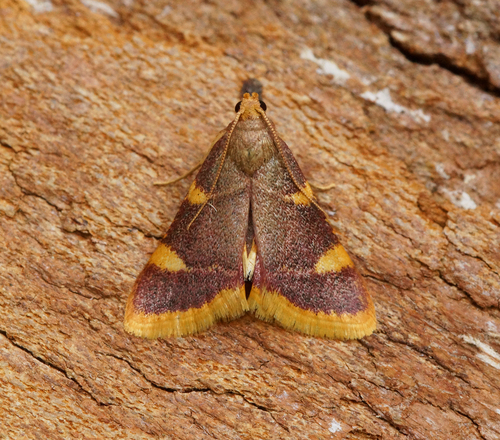


Clover Hayworm Moth
hypsopygia costalis
The Clover Hayworm Moth, known scientifically as Hypsopygia costalis, is a striking, albeit small, moth species belonging to the snout moth family (Pyralidae). Known in some regions as the Gold Triangle, this insect brings a splash of unexpected color to rural barns and grassy fields across Europe and North America. While adults are visually celebrated for their rich, velvety coloration, the species is perhaps best known for its larval stage. The caterpillars are uniquely adapted to feed on dry plant matter, frequently targeting stored clover and hay. Because they spin silk to bind their dry food sources together, they have historically been considered a minor agricultural pest. Despite this reputation, the Clover Hayworm Moth remains a fascinating example of how insects adapt to human-altered environments, carving out a niche within agricultural storage. Watching this delicate, crimson-and-gold moth flutter around barn lights on a warm summer evening is a true delight for macro-photographers and insect enthusiasts alike.
Habitat: Found primarily in grassy fields, agricultural areas, and near human-made structures like barns and silos where dried clover or hay is stored.
Hypsopygia costalis is easily recognized by its rich purplish-red to maroon wings, adorned with vibrant golden-yellow fringes along the trailing edges. The forewings feature two prominent, bright yellow spots on the leading edge; when the moth rests with its wings spread flat or slightly tented, these spots and fringes often create the illusion of golden triangles. It is a relatively small moth, possessing a wingspan typically ranging from 16 to 22 millimeters. The body matches the purplish hue of the wings, while the legs are banded with yellow, completing its striking, jewel-like appearance.
Category
InsectsRarity
Common
Danger
1/5 · Very low
Snaps
Be the first to snap!
Because its caterpillars feast on dry hay, the Clover Hayworm Moth was once considered a significant pest by 19th-century farmers trying to store winter feed for livestock.
Despite its rich crimson and gold coloring, its primary defense is simply hiding in the dark crevices of barns and woodpiles during the daytime.
In the UK, this beautiful species is often called the 'Gold Triangle' due to the striking geometric yellow patterns created when it folds its wings.
When the larvae bind hay together with their silk, they can create dense, moldy mats that sometimes force farmers to discard entire bales.
The caterpillars produce copious amounts of silk, binding together dried clover and hay leaves to create protective feeding galleries.
Unlike most caterpillars that require fresh leaves, the larvae possess specialized gut enzymes to digest highly desiccated, dead plant material.
The adults possess highly sensitive night vision and are strongly drawn to artificial light sources, often bringing them to farmhouses and barns.
The larvae feed almost exclusively on dried plant matter, particularly stored clover and hay, while adult moths may occasionally feed on nectar.
Age differences: Larvae consume dried agricultural plant matter, whereas the short-lived adults transition to consuming liquid nectar or do not feed at all.
No trait badges are assigned for this object yet.
No aliases listed yet.
Collections for this object will appear here as more themes are added.
Danger
1/5 · Very low
No special safety notes yet.
Compare resting wing shape, forewing markings, antennae and body build. Small brown moths can hinge on fine details a phone photo can't always catch. Moth Identifier: upload a photo and compare the visible details.
1-2 cm
1-2 cm
0.0001-0.0003 kg
0-1 years
5 km/h
The larvae feed almost exclusively on dried plant matter, particularly stored clover and hay, while adult moths may occasionally feed on nectar.
Found primarily in grassy fields, agricultural areas, and near human-made structures like barns and silos where dried clover or hay is stored.
Zoom in to split clusters and explore where this object has been snapped.
Recent snaps will appear here as new observations are added.
Take the discovery with you
Snap it with Snappit to identify it, learn what makes it special, and add the discovery to your collection.