

Coast Mountain Kingsnake
lampropeltis multifasciata
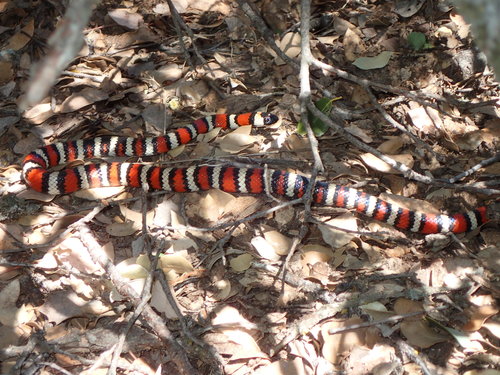
The Coast Mountain Kingsnake is a stunningly vibrant reptile native to the montane and coastal regions of the western United States. Renowned for its brilliant tricolor pattern of red, black, and white bands, this secretive snake is a true crown jewel of western herpetofauna. It is highly valued by nature enthusiasts for its striking appearance and elusive nature. Though completely harmless to humans, its mimicry of venomous species provides a fascinating lesson in evolutionary defense. It spends much of its life hidden away, making any sighting a memorable event.
Habitat: Found in damp, rocky canyons and coniferous or mixed-oak forests of coastal and mountain regions, often near streams or under rotting logs.
This slender snake typically measures between 50 to 100 centimeters in length and is instantly recognizable by its bold, repeating pattern of red, black, and white or cream-colored rings. The red bands are bordered on both sides by black, which separates them from the white bands. It has smooth, glossy scales that give it a polished appearance, a small head that is barely wider than its neck, and dark, round eyes.
Category
ReptilesRarity
Common
Danger
1/5 · Very low
Snaps
Be the first to snap!
Their mimicry of coral snakes is considered a 'ghost mimicry' in northern regions, as actual coral snakes do not overlap in their range.
They are highly fossorial, spending up to ninety-five percent of their lives hidden beneath the leaf litter, soil, or rocks.
When threatened, they may vibrate their tails against dry leaves to produce a buzzing sound that mimics a rattlesnake.
Displays bright warning coloration mimicking venomous coral snakes to discourage potential predators, despite being completely harmless.
Possesses a natural immunity to the venom of local pit vipers, allowing it to safely hunt and consume rattlesnakes.
Utilizes tight body coils to exert high pressure on prey, quickly cutting off circulatory flow before ingestion.
A specialized carnivore that feeds on lizards, small mammals, and other snakes, utilizing constriction to subdue its prey.
Age differences: Juveniles consume mostly small lizards and salamanders, while adults take larger prey like rodents and other snakes.

Crotalus oreganus
Preyed upon by the kingsnake, which is immune to its potent hemotoxic venom.

Sceloporus occidentalis
A common reptilian prey species for both juvenile and adult kingsnakes.

Buteo jamaicensis
A formidable aerial predator that hunts kingsnakes in open clearings.
No trait badges are assigned for this object yet.
Collections for this object will appear here as more themes are added.
Danger
1/5 · Very low
No special safety notes yet.
Compare the full body pattern, build, head markings and tail. Color can shift with age and lighting. Rules of thumb about triangular heads or round pupils aren't a reliable way to tell whether a snake is venomous. Snake Identifier: upload a photo and compare the visible details.
50-100 cm
0.1-0.4 kg
10-20 years
5 km/h
A specialized carnivore that feeds on lizards, small mammals, and other snakes, utilizing constriction to subdue its prey.
Found in damp, rocky canyons and coniferous or mixed-oak forests of coastal and mountain regions, often near streams or under rotting logs.
Constriction
Zoom in to split clusters and explore where this object has been snapped.
Recent snaps will appear here as new observations are added.
Take the discovery with you
Snap it with Snappit to identify it, learn what makes it special, and add the discovery to your collection.