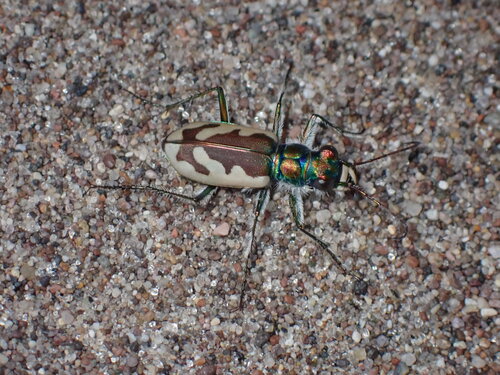


Colorado Dune Tiger Beetle
cicindela theatina
The Colorado Dune Tiger Beetle (Cicindela theatina) is a striking, highly specialized insect endemic only to the Great Sand Dunes of southern Colorado. Navigating one of North America's most extreme environments, this vibrant beetle is renowned for its incredible agility and speed. It serves as a keystone micro-predator of the sand dunes, sprint-hunting other small arthropods across the scorching shifting sands. Its existence is a testament to extreme adaptation, living in an environment where surface temperatures can fluctuate wildly.
Habitat: Found exclusively on the active and semi-stabilized sand dunes of the Great Sand Dunes National Park and Preserve in Colorado.
This beetle is characterized by its brilliant metallic green to bronze-brown elytra featuring broad, creamy-white markings that dominate much of its upper body, helping it blend seamlessly into the sandy background. It is relatively small, measuring roughly 1.1 to 1.4 centimeters in length. It possesses large, bulging compound eyes for excellent vision, long, slender legs built for rapid running, and formidable, sickle-shaped mandibles used to seize prey.
Category
InsectsRarity
Common
Danger
1/5 · Very low
Snaps
Be the first to snap!
The larvae act like tiny subterranean jacks-in-the-box, anchoring themselves inside vertical burrows with a specialized dorsal hook to pull passing insects underground.
These beetles run so fast that they temporarily go blind; their brains cannot process visual information at such high speeds, forcing them to stop frequently to relocate their prey.
They are endemic exclusively to the Great Sand Dunes of Colorado, meaning they are found naturally nowhere else on Earth.
Utilizes exceptionally long, slender legs to lift its body off the hot sand, reducing heat absorption while running at blazing speeds.
Digs rapid, temporary burrows into the sand to escape extreme midday heat and freezing nighttime temperatures.
Uses large, high-resolution compound eyes to spot tiny prey movements from afar, initiating lightning-fast chase sequences.
Both adults and larvae are voracious predators, feeding on a variety of small dune-dwelling insects and arthropods.
Age differences: Larvae live in vertical sand burrows and ambush passing prey, whereas adults actively pursue prey on the surface.
No trait badges are assigned for this object yet.
No aliases listed yet.
Collections for this object will appear here as more themes are added.
Danger
1/5 · Very low
No special safety notes yet.
Look for hard wing covers meeting in a line down the back, then compare the antennae, body shape, legs and markings. Metallic colors shift a lot with lighting. Beetle Identifier: upload a photo and compare the visible details.
1 cm
2-3 cm
0.0001-0.0003 kg
1-2 years
8 km/h
Both adults and larvae are voracious predators, feeding on a variety of small dune-dwelling insects and arthropods.
Found exclusively on the active and semi-stabilized sand dunes of the Great Sand Dunes National Park and Preserve in Colorado.
Zoom in to split clusters and explore where this object has been snapped.
Recent snaps will appear here as new observations are added.
Take the discovery with you
Snap it with Snappit to identify it, learn what makes it special, and add the discovery to your collection.