Common Greenshield Lichen
flavoparmelia caperata
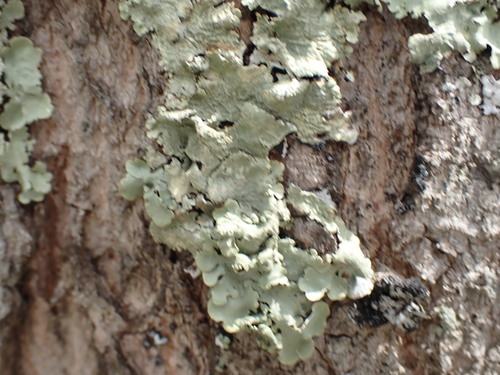
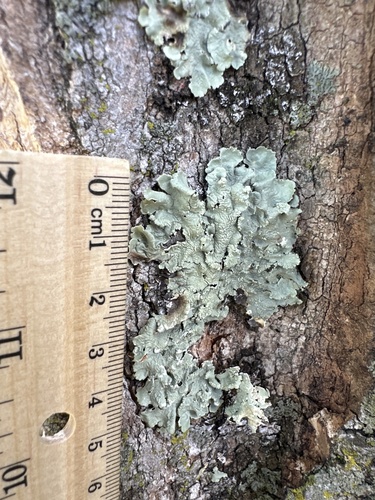
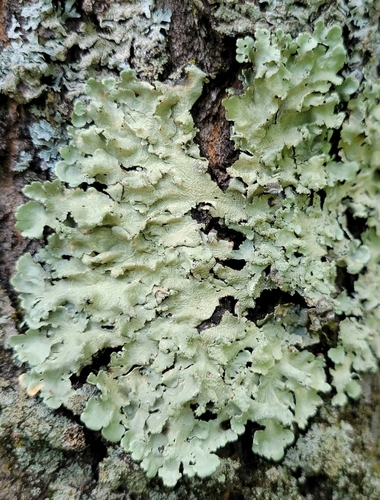
The Common Greenshield Lichen is a bright green lichen that often grows on rocks and trees. It looks like a little green shield and helps make our air clean!
Habitat: Commonly found on tree bark, rocks, and soil in forests and urban areas.
The Common Greenshield Lichen has a distinctive bright yellow-green to gray-green, shield-like thallus that can grow quite large. Its wrinkled surface often features powdery soredia near the lobe tips, giving it a somewhat bumpy texture. The edges are often slightly ruffled, setting it apart from flatter, smoother lichens.
Category
FungiRarity
Common
Danger
0/5 · No known danger
Snaps
8
It produces tiny powdery bits called soredia to spread to new places!
Its tough, leathery texture helps it survive strong winds and harsh weather!
Lichens are amazing pioneers, often the first life to colonize bare rock!
This lichen can grow incredibly slowly, sometimes just a millimeter a year!
Common Greenshield Lichen can soak up nutrients (and pollutants!) from the air, helping scientists understand air quality.
Common Greenshield Lichen has a tiny algae chef inside that makes sugary food using sunlight, just like plants!
Common Greenshield Lichen can dry up completely when it's parched, then spring back to life when water returns.

Arion ater
Provides a food source for grazing slugs.
Quercus rubra
Grows on the rough bark of oak trees.
Acer saccharum
Attaches to maple tree trunks for support.
Camouflaged describes organisms that possess coloring or patterns that allow them to blend into their environment.
Colorful describes organisms or objects displaying a wide range of bright and distinct colors.
Describes organisms that break down dead organic material, recycling nutrients back into the ecosystem.
Forest habitats are terrestrial environments dominated by dense tree cover, supporting a high diversity of plant and animal life.

Diurnal animals are primarily active during daylight hours, typically resting or sleeping at night.
Danger
0/5 · No known danger
No special safety notes yet.
The easiest way to identify Common Greenshield Lichen is to use the Snappit nature identifier app.
0.1-0.5 cm
inedible
Commonly found on tree bark, rocks, and soil in forests and urban areas.
wood
Year-round
Zoom in to split clusters and explore where this object has been snapped.
May 10, 2026
Milton Center Historic DistrictPhoto attribution
(c) Hydrocycler (Elizabeth Dougherty), some rights reserved (CC BY)
License: CC BY 4.0 ↗
Image may be shown cropped inside the card frame.
Jul 28, 2025
Fox Chase FarmPhoto attribution
(c) Annie Evankow, some rights reserved (CC BY)
License: CC BY 4.0 ↗
Image may be shown cropped inside the card frame.
Jul 2, 2023
Canoe Landing Prairie State Natural AreaPhoto attribution
(c) aarongunnar, some rights reserved (CC BY)
License: CC BY 4.0 ↗
Image may be shown cropped inside the card frame.

Wisconsin, US
You might spot Turkey, White-Tailed Deer, and Dame's Rocket.
View guide →

New York, US
You might spot American Toad and Intermediate Wood Fern.
View guide →

Pennsylvania, US
You might spot Canada Goose, American Robin, and Red-Winged Blackbird.
View guide →

Massachusetts, US
You might spot Common Eastern Bumble Bee, Bee, and American Robin.
View guide →

Massachusetts, US
You might spot Common Eastern Bumble Bee, Bee, and American Robin.
View guide →

Wisconsin, US
You might spot Sundial Lupine, Aurora Damsel, and Lancet Clubtail.
View guide →
Take the discovery with you
Snap it with Snappit to identify it, learn what makes it special, and add the discovery to your collection.