





Common Whitlowgrass
Draba verna
Common Whitlowgrass is a small, cheerful plant that blooms with pretty yellow flowers in spring. It loves to grow in grassy places and can even pop up in your backyard!
Habitat: Grasslands
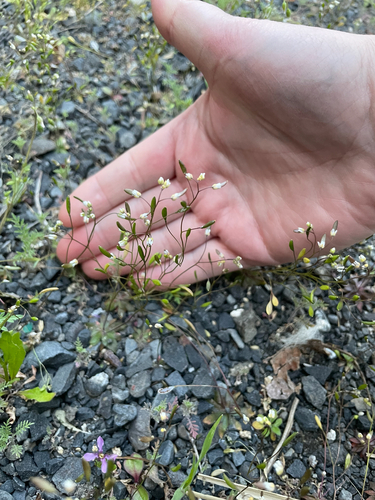
The Common Whitlowgrass is a tiny annual plant with a basal rosette of narrow, hairy grey-green leaves. It produces very small, white, four-petaled flowers on leafless stems. These flowers often appear like a dusting of snow on the ground.
Category
PlantsRarity
Common
Danger
1/5 · Very low
Snaps
1
Each tiny flower has exactly four petals, perfectly arranged like a miniature white cross!
Its old name, 'whitlowgrass,' comes from a belief it could cure a finger infection!
This plant is one of the very first flowers to pop up, often when it's still cold outside!
You could fit several of its flowers on your pinky fingernail – they are incredibly small!
Common Whitlowgrass can sprout and flower incredibly fast in early spring, helping it complete its life cycle before larger plants take over.
Common Whitlowgrass can tolerate chilly temperatures, which helps it be one of the very first plants to bloom in spring.
Common Whitlowgrass has tiny, lightweight seeds that are easily carried by wind or water, helping it spread to new places.
Andrena haemorrhoa
Visits early spring flowers for nectar.
Deroceras reticulatum
Feeds on its small leaves and shoots.
Myrmica rubra
Carries its seeds to new places to grow.
Flowering plants are any plants that produce flowers as part of their reproductive cycle.
Biennial plants complete their life cycle over two growing seasons, typically forming foliage in the first year and flowering/seeding in the second.
Spring blooming plants produce their flowers during the spring season, often signifying the end of winter and the start of new growth.
Edible plants are those parts of a plant that are considered safe for human consumption.

Grassland habitats are terrestrial biomes dominated by grasses and herbaceous plants, supporting a variety of grazing animals.

Describes plants that are particularly attractive and beneficial to a wide range of pollinating organisms.

Rapid growing plants exhibit accelerated growth rates, quickly increasing in size and biomass within a short period.

This habitat trait indicates species that can coexist with humans in urban and suburban environments, utilizing man-made structures and green spaces.
No aliases listed yet.
Danger
1/5 · Very low
Always look but don't touch plants unless you know they are safe!
The easiest way to identify Common Whitlowgrass is to use the Snappit nature identifier app.
2-10 cm
5-15 cm
0.2-0.4 cm
Early Spring
Yes
None
Annual
Zoom in to split clusters and explore where this object has been snapped.
Apr 5, 2026
Grand CouleePhoto attribution
(c) solidstate, some rights reserved (CC BY)
License: CC BY 4.0 ↗
Image may be shown cropped inside the card frame.
Take the discovery with you
Snap it with Snappit to identify it, learn what makes it special, and add the discovery to your collection.









.jpg&width=800)



_001.jpg&width=800)



