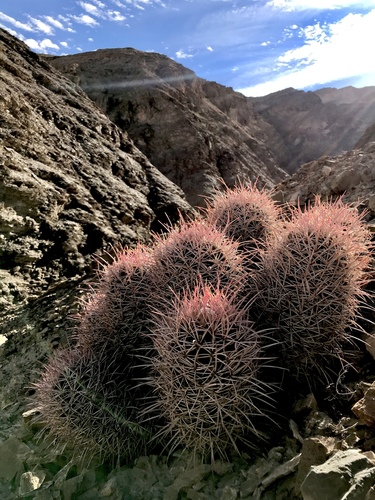


Cottontop Cactus
homalocephala polycephala
The Cottontop Cactus (Homalocephala polycephala) is a striking, multi-headed barrel cactus native to the extremely arid deserts of the American Southwest. Easily recognized by its dense, protective canopy of thick, overlapping spines and white woolly crowns, this resilient plant thrives in some of the harshest, driest environments on Earth. It often forms dense clumps or mounds containing up to a hundred individual stems, creating a dramatic, fortress-like appearance on rocky desert hillsides. As a slow-growing survivor, it plays a vital role in its desert ecosystem, providing nesting shelter and nourishment for local wildlife. During late spring, its woolly tops burst into vibrant yellow flowers with red centers, contrasting beautifully against its formidable, interlocking armor.
Habitat: Found on extremely dry, rocky slopes, gravelly alluvial fans, and canyon walls within the Mojave and Sonoran Deserts.
This cactus grows in clustered mounds of globose to cylindrical stems, with individual stems reaching up to 60 centimeters in height. The stems are heavily guarded by thick, heavily ringed, reddish-grey to straw-colored spines that flatten and curve slightly. The most distinctive feature is the dense white wool that covers the growing tip of each stem, from which small, yellow, funnel-shaped flowers emerge.
Category
PlantsRarity
Common
Danger
1/5 · Very low
Snaps
4
A single massive cluster of Cottontop Cactus can contain over a hundred individual heads and take more than a century to grow to full size.
Its heavily ringed, rigid spines are so tough and sharp that they can easily puncture standard vehicle tires.
The dense, woolly fibers at the top of the cactus were historically used by Native Americans as a soft filling material and for starting fires.
The dense white wool at the crown insulates delicate growing tissues from extreme solar radiation and freezing night temperatures.
It grows in tight, multi-headed mounds that reduce wind exposure, collect water efficiently, and deter large herbivores with a dense grid of overlapping spines.
Like many desert plants, it opens its stomata at night to absorb carbon dioxide, dramatically reducing water loss during the scorching desert day.
As a photosynthetic plant, it produces its own energy using sunlight, water, and carbon dioxide.
Neotoma lepida
Chews on the fleshy stems of the cactus to obtain moisture and nutrients in the desert.

Campylorhynchus brunneicapillus
Builds nests deep within the protective, spiny branches to shield nestlings from predators.
No trait badges are assigned for this object yet.
No aliases listed yet.
Collections for this object will appear here as more themes are added.
Danger
1/5 · Very low
No special safety notes yet.
The easiest way to identify Cottontop Cactus is to use the Snappit nature identifier app.
10-60 cm
5-150 kg
50-150 years
As a photosynthetic plant, it produces its own energy using sunlight, water, and carbon dioxide.
Found on extremely dry, rocky slopes, gravelly alluvial fans, and canyon walls within the Mojave and Sonoran Deserts.
Zoom in to split clusters and explore where this object has been snapped.

California, US
You might spot Desert Holly, Western Joshua Tree, and Creosote Bush.
View guide →

California, US
You might spot Frémont's Phacelia and Devil's Spineflower.
View guide →

California, US
You might spot Iodinebush, Yerba Mansa, and Golden Gilmania.
View guide →

California, US
You might spot Creosote Bush, Desert Holly, and Cottontop Cactus.
View guide →

California, US
You might spot Desert Paintbrush and Desert Milkweed.
View guide →
Take the discovery with you
Snap it with Snappit to identify it, learn what makes it special, and add the discovery to your collection.











.jpg&width=800)



_001.jpg&width=800)




