





crane-fly orchid
Tipularia discolor
The crane-fly orchid is a special flower that looks like a tiny crane in flight! It has beautiful greenish flowers that bloom in the spring, often hiding in the woods.
Habitat: Forests
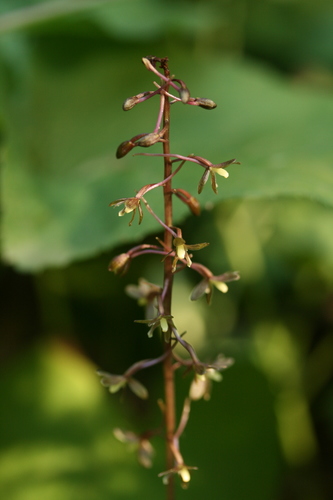
The crane-fly orchid has a single, ribbed leaf that is dark green on top and rich purple underneath. Its tall, slender stalk bears small, greenish-brown flowers with thin petals that resemble tiny crane-flies.
Category
PlantsRarity
Common
Danger
1/5 · Very low
Snaps
5
Its scientific name, discolor, means "two colors" because its leaf is green on top and purple underneath!
Some people say its tiny flowers smell like sweet apples or spicy cloves!
This sneaky orchid often disappears in spring, leaving no trace until its flower stalk pops up in summer!
Unlike many plants, it grows its leaf in the fall and keeps it all winter long!
The crane-fly orchid grows a single leaf in fall that survives all winter, soaking up sun when tree leaves are gone!
Its small, greenish-brown flowers open at night and release a sweet scent to guide long-tongued moths in the darkness.
This orchid has a hidden chain of round, starchy tubers beneath the soil, storing food for years like a secret pantry!
Agrotis ipsilon
Moth pollinates orchid by visiting its night-blooming flowers.
Tulasnella calospora
Fungus helps orchid absorb nutrients from the soil for survival.

Odocoileus virginianus
Deer may browse on the orchid's leaves or flower stalks.
Flowering plants are any plants that produce flowers as part of their reproductive cycle.
Shade tolerant plants are adapted to grow and thrive in areas with low light levels, requiring less direct sunlight.
Spring blooming plants produce their flowers during the spring season, often signifying the end of winter and the start of new growth.
Describes plants that are particularly attractive and beneficial to a wide range of pollinating organisms.

Describes a relationship between two different species where they live in close association, often benefiting one or both.

Forest habitats are terrestrial environments dominated by dense tree cover, supporting a high diversity of plant and animal life.

This trait characterizes organisms with an exceptionally long lifespan compared to others of their kind.

Endangered status indicates a species is at a very high risk of extinction in the wild in the near future.
No aliases listed yet.
Danger
1/5 · Very low
Always look at flowers from a distance and never pick them without permission.
The easiest way to identify crane-fly orchid is to use the Snappit nature identifier app.
30-60 cm
10-20 cm
1-1.5 cm
Summer
No
None
Perennial
Zoom in to split clusters and explore where this object has been snapped.

Maryland, US
You might spot American Bullfrog and Fowler's Toad.
View guide →

Kentucky, US
You might spot Pond Slider, Crane-Fly Orchid, and Bloodroot.
View guide →

Virginia, US
You might spot White-Tailed Deer and Spotted Salamander.
View guide →

Maryland, US
You might spot Pink Lady's Slipper and Eastern Red-Backed Salamander.
View guide →

Virginia, US
You might spot Striped Wintergreen, Fan Clubmoss, and Mountain Laurel.
View guide →
Virginia, US
You might spot Crane-Fly Orchid, Wild Geranium, and Cutleaf Coneflower.
View guide →
Take the discovery with you
Snap it with Snappit to identify it, learn what makes it special, and add the discovery to your collection.







.jpg&width=800)



_001.jpg&width=800)


