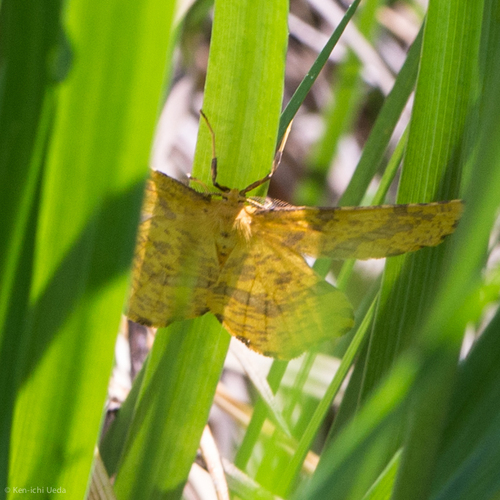


Crocus Geometer Moths
xanthotype
Xanthotype moths, commonly known as Crocus Geometers, are a striking genus of moths that bring a splash of vibrant yellow to North American woodlands and gardens. Belonging to the Geometridae family, their caterpillars are classic "inchworms" that move by looping their bodies. These moths are particularly notable for their bright, crocus-like yellow wings adorned with variable purplish or brownish speckles and bands. They are a delightful find for nature enthusiasts during the warm summer months, often fluttering actively at dusk or resting conspicuously on foliage during the day. Their cryptic caterpillars, on the other hand, are masters of disguise, perfectly mimicking the twigs of their host plants to evade predators. The contrast between the highly camouflaged larva and the boldly colored adult makes the Crocus Geometer a fascinating subject of study in insect development and adaptation.
Habitat: Typically found in deciduous woodlands, forest edges, shrubby thickets, and suburban gardens where host plants are abundant.
Crocus Geometer Moths are medium-sized moths with a wingspan ranging roughly from 3 to 5 centimeters. Their most defining feature is their striking, bright yellow base color, which closely resembles the petals of a blooming crocus flower. Both the forewings and hindwings are typically heavily speckled, spotted, or banded with pale brownish, pinkish, or purplish markings. The intensity of these patterns varies significantly between individuals and sexes; females are often larger and noticeably less spotted than the heavily speckled males. When resting, they typically hold their wings flat and spread out, beautifully showcasing their intricate geometric patterns.
Category
InsectsRarity
Common
Danger
1/5 · Very low
Snaps
Be the first to snap!
Despite their bright, conspicuous yellow color as adults, their caterpillar stage relies entirely on being invisible to predators by perfectly mimicking a broken twig.
Female Crocus Geometers are typically less heavily spotted than males, making it sometimes possible to guess their sex just by glancing at their wing patterns.
The family name 'Geometridae' comes from the Greek words for 'earth measurer', inspired by how their inchworm caterpillars seem to measure the ground as they loop along.
The caterpillars of this genus perfectly camouflage themselves as small dead twigs, complete with bark-like textures and tiny bumps, rendering them nearly invisible to predators.
As members of the Geometridae family, the larvae lack middle prolegs, causing them to move in a distinctive, energy-efficient "inching" or looping manner.
Male and female moths exhibit noticeable differences in their markings, with males generally displaying much heavier, darker speckling across their yellow wings.
Caterpillars feed extensively on the leaves of various deciduous trees, shrubs, and herbaceous plants, while adults consume flower nectar.
Age differences: Larvae are voracious folivores consuming solid plant tissue, whereas adults transition to a liquid diet, drinking nectar from flowers.

Cornus florida
Larvae frequently feed on the leaves of flowering dogwoods.

Poecile atricapillus
Adults and caterpillars are preyed upon by insectivorous woodland birds.
Solidago canadensis
Caterpillars utilize goldenrod foliage as a food source during the summer months.
No trait badges are assigned for this object yet.
No aliases listed yet.
Collections for this object will appear here as more themes are added.
Danger
1/5 · Very low
No special safety notes yet.
Compare resting wing shape, forewing markings, antennae and body build. Small brown moths can hinge on fine details a phone photo can't always catch. Moth Identifier: upload a photo and compare the visible details.
1-3 cm
3-5 cm
0.0001-0.0005 kg
0-1 years
Caterpillars feed extensively on the leaves of various deciduous trees, shrubs, and herbaceous plants, while adults consume flower nectar.
Typically found in deciduous woodlands, forest edges, shrubby thickets, and suburban gardens where host plants are abundant.
Foraging
Zoom in to split clusters and explore where this object has been snapped.
Recent snaps will appear here as new observations are added.
Take the discovery with you
Snap it with Snappit to identify it, learn what makes it special, and add the discovery to your collection.