

Decollate Snail
rumina decollata
The Decollate Snail, Rumina decollata, is a fascinating and often misunderstood terrestrial gastropod known for its unique shell and predatory habits. Unlike most garden snails that are herbivores, the Decollate Snail is primarily a carnivore, making it a valuable ally in gardens by preying on other pest snails and slugs. Its distinctive 'decollated' shell, which appears to have had its tip broken off, is a natural part of its growth process and aids in identification. This species plays an important ecological role in controlling gastropod populations, though it can also become a minor pest to certain cultivated plants if other food sources are scarce. Its adaptability has allowed it to establish populations in various regions worldwide.
Habitat: Found in gardens, agricultural fields, vineyards, orchards, and other disturbed areas with well-drained soil and abundant leaf litter or ground cover.
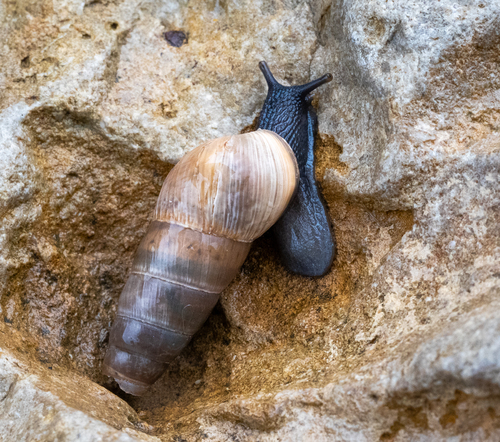
The Decollate Snail has a distinctive conical shell, typically light brown to yellowish-brown, which can reach 2 to 5 cm in length. Its most striking feature is its 'decollated' apex; as the snail grows, the upper whorls of its shell are naturally shed, leaving a truncated, blunt tip. The body of the snail is grey to light brown, and it has two pairs of tentacles, with the upper, longer pair bearing eyes at their tips. The shell's surface is often glossy with fine growth lines.
Category
InvertebrateRarity
Common
Danger
1/5 · Very low
Snaps
1
Decollate Snails can survive long periods of drought or cold by burrowing deep into the soil and entering a dormant state known as aestivation or hibernation, sealing themselves with a mucous plug.
The Decollate Snail earns its name because the upper, older whorls of its shell naturally break off as it grows, leaving a blunt or 'decollated' apex.
They are hermaphroditic, meaning each individual possesses both male and female reproductive organs, capable of self-fertilization or mating with another snail.
Unlike most garden snails, which primarily eat plants, the Decollate Snail is a natural predator, primarily feasting on other snails and slugs, making it a 'good guy' in many gardens.
This snail actively hunts and preys on other species of snails and slugs, making it a natural biocontrol agent. It uses its radula to consume its prey, often entering the shells of smaller snails.
As the snail matures, the older, apical whorls of its shell naturally break off, giving it a distinctive blunt appearance. This process, known as decollation, helps it adapt to burrowing and possibly sheds parasitic burdens.
Decollate Snails are capable burrowers, which allows them to seek refuge from heat, drought, and cold. They can aestivate (enter a dormant state during hot, dry periods) or hibernate in the soil, protecting them from adverse environmental conditions.
The Decollate Snail is primarily a carnivore, preying on other smaller snails and slugs. However, it is also an opportunistic omnivore, consuming decaying plant material and some live plants, especially when animal protein is scarce.
Age differences: Juvenile Decollate Snails initially consume more decaying plant matter and fungi, gradually shifting to a more carnivorous diet as they mature and grow larger.
Cornu aspersum
Main food source, particularly smaller or juvenile individuals.
Deroceras reticulatum
Another primary food source for the Decollate Snail, especially slug eggs and smaller individuals.
Turdus migratorius
Predator that consumes snails, including Decollate Snails, when foraging in gardens.
Armadillidium vulgare
Can be a competitor for resources like decaying plant matter, especially in areas with limited pest snail populations.
No trait badges are assigned for this object yet.
No aliases listed yet.
Collections for this object will appear here as more themes are added.
Danger
1/5 · Very low
No special safety notes yet.
The easiest way to identify Decollate Snail is to use the Snappit nature identifier app.
2-5 cm
0.001-0.005 kg
2-4 years
The Decollate Snail is primarily a carnivore, preying on other smaller snails and slugs. However, it is also an opportunistic omnivore, consuming decaying plant material and some live plants, especially when animal protein is scarce.
Found in gardens, agricultural fields, vineyards, orchards, and other disturbed areas with well-drained soil and abundant leaf litter or ground cover.
Foraging
20-200
Zoom in to split clusters and explore where this object has been snapped.
Take the discovery with you
Snap it with Snappit to identify it, learn what makes it special, and add the discovery to your collection.