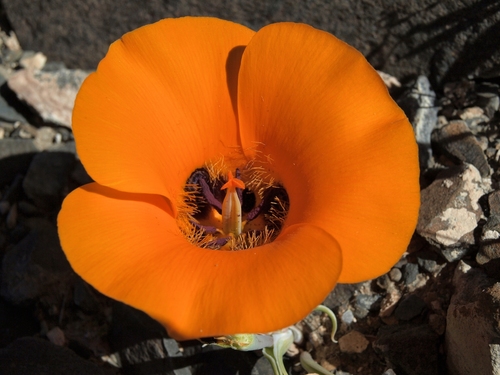


Desert Mariposa Lily
calochortus kennedyi
The Desert Mariposa Lily (Calochortus kennedyi) is a striking perennial wildflower native to the arid desert regions of the southwestern United States and northern Mexico. Rising from deep underground bulbs, this resilient plant braves some of the harshest environments on Earth to produce brilliantly colored flowers. In late spring, its blossoms burst forth in vibrant shades of fiery orange, vermilion, or occasionally yellow, creating a stunning contrast against the muted, sandy soils of its habitat. Historically, the plant held cultural significance for Indigenous peoples, who harvested the bulbs as a valuable food source. Today, it is highly sought after by nature enthusiasts and photographers eager to catch a glimpse of its ephemeral, glowing petals.
Habitat: Found in dry, sandy, or rocky soils of desert scrublands, pinyon-juniper woodlands, and open slopes across the Mojave, Sonoran, and Great Basin deserts.
This plant stands between 10 and 50 centimeters tall, featuring a slender, often unbranched stem with narrow, grass-like leaves that tend to wither before blooming. The flowers are cup- or bell-shaped, measuring about 3 to 5 centimeters across, and consist of three large, fan-like petals. These petals are most famously a vivid, intense orange-red, although yellow-petaled varieties exist in certain regions. Inside the base of each petal lies a distinct, dark purple or near-black crescent-shaped blotch, often fringed with small, yellow hairs, which serves as a guide for desert pollinators.
Category
PlantsRarity
Common
Danger
1/5 · Very low
Snaps
Be the first to snap!
In years with little to no winter rain, the lily will completely bypass sprouting, remaining dormant and protected deep within the dry earth for multiple seasons.
Indigenous peoples of the Southwest, including the Paiute and Navajo, traditionally collected the sweet bulbs to eat raw, boiled, or roasted.
The genus name 'Calochortus' is derived from Greek, meaning 'beautiful grass', which perfectly describes the plant's elegant grass-like foliage and stunning blossoms.
The plant can remain completely dormant underground as a bulb during extremely dry years, waiting out droughts until sufficient winter rainfall triggers growth.
It forms vital symbiotic relationships with underground fungi, allowing it to efficiently extract scarce nutrients and moisture from nutrient-poor desert soils.
The distinct, dark ultraviolet-absorbing patches and hairs at the base of the petals act as a visual bullseye to guide native bees directly to its nectar and pollen.
As a photosynthetic plant, it synthesizes its own energy from sunlight, carbon dioxide, and water while absorbing key mineral nutrients from the soil.
Lasioglossum sisymbrii
The Desert Sweat Bee feeds on the nectar and pollen of the Desert Mariposa Lily, acting as its primary pollinator.

Thomomys bottae
Botta's Pocket Gopher digs up and consumes the nutrient-dense underground bulbs of the lily as a key food resource.
Chlosyne acastus
The Sagebrush Checkerspot butterfly visits the brilliant orange flowers to drink nectar, facilitating cross-pollination.
No trait badges are assigned for this object yet.
No aliases listed yet.
Collections for this object will appear here as more themes are added.
Danger
1/5 · Very low
No special safety notes yet.
Start with the whole plant, then compare leaf arrangement, leaf edges, stems and any flowers or fruit. Opposite leaves grow in pairs; alternate leaves come one at a time along the stem. These details tell you far more together than a single green leaf does. Plant Identifier: upload a photo and compare the visible details.
10-50 cm
5-15 years
As a photosynthetic plant, it synthesizes its own energy from sunlight, carbon dioxide, and water while absorbing key mineral nutrients from the soil.
Found in dry, sandy, or rocky soils of desert scrublands, pinyon-juniper woodlands, and open slopes across the Mojave, Sonoran, and Great Basin deserts.
Zoom in to split clusters and explore where this object has been snapped.
Recent snaps will appear here as new observations are added.
Take the discovery with you
Snap it with Snappit to identify it, learn what makes it special, and add the discovery to your collection.