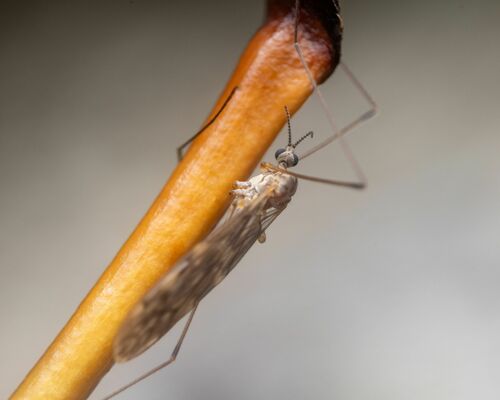





Dicranomyia marmorata
Dicranomyia marmorata
Dicranomyia marmorata is a special type of fly that has beautiful patterns on its wings. These tiny insects love to live in wet places and are often seen near water, making them fun to spot!
Habitat: Wetlands
The Dicranomyia marmorata is a small, slender cranefly characterized by its beautifully mottled, marble-like wings, which give it its name. It has a brownish or grayish body and notably long, delicate legs that easily break off. This fly lacks the piercing mouthparts of mosquitoes.
Category
InsectsRarity
Common
Danger
1/5 · Very low
Snaps
Be the first to snap!
Even though they have very long, spindly legs, these flies are quite slow and clumsy fliers!
Many cranefly larvae can actually live underwater for months, breathing through special tubes!
The 'marmorata' in its name means 'marbled', perfectly describing its unique, patterned wings!
They are sometimes mistaken for giant mosquitoes, but these harmless insects never bite humans!
Dicranomyia marmorata has beautifully mottled wings that helps them disappear against dappled light and decaying leaves on the forest floor.
Dicranomyia marmorata larvae can break down decaying plant matter because of their specialized mouthparts that help them recycle forest nutrients.
Dicranomyia marmorata uses its long, delicate antennae that helps them find mates and navigate through their damp environments.
Larvae are nature's recyclers, munching on decaying plants; adults may sip nectar or just water.
Age differences: Larvae are detritivores, adults may feed on nectar or just water.

Erithacus rubecula
Common garden bird that preys on various insects.
Araneus diadematus
Often traps flies in its intricate orb webs.
Quercus robur
Larvae thrive on decaying oak leaves and wood as food.
Marked with spots or patches of a different color.
Solitary animals live alone for most of their lives, only interacting with others for mating or parental care.
Aerial creatures spend a significant portion of their lives airborne, utilizing flight for various activities such as hunting, migration, or nesting.
This trait identifies organisms whose diet includes both plant and animal matter.
Colorful describes organisms or objects displaying a wide range of bright and distinct colors.
This habitat trait identifies species found in wetlands, which are areas of land saturated with water, either permanently or seasonally, including marshes, swamps, and bogs.
Diurnal animals are primarily active during daylight hours, typically resting or sleeping at night.
Freshwater habitats include non-saline aquatic environments such as rivers, lakes, ponds, and wetlands, vital for numerous species.
Describes a species whose presence and role have a disproportionately large effect on its environment.
Describes organisms that transfer pollen, enabling the fertilization and reproduction of plants.
No aliases listed yet.
Danger
1/5 · Very low
These flies are harmless, but it's always good to watch insects from a distance.
Look for six legs, antennae, three body sections and the shape of the wings. Beetles have hardened front wings; flies have just one working pair. Tiny insects may need a close view before their group is clear. Insect Identifier: upload a photo and compare the visible details.
8-15 mm
4-7 mm
7-14 days
5 km/h
Larvae are nature's recyclers, munching on decaying plants; adults may sip nectar or just water.
Wetlands
Foraging
Zoom in to split clusters and explore where this object has been snapped.
Recent snaps will appear here as new observations are added.
Take the discovery with you
Snap it with Snappit to identify it, learn what makes it special, and add the discovery to your collection.