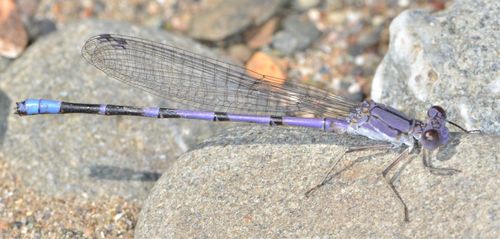


Emma'S Dancer
argia emma
Emma's Dancer (Argia emma) is a striking damselfly species belonging to the 'dancer' genus, known for its agile flight and vibrant coloration, particularly in males. These delicate insects are an integral part of freshwater ecosystems across western North America, acting as efficient predators of small flying insects. Their presence often indicates good water quality, making them a fascinating subject for nature enthusiasts and a valuable bioindicator. With their intricate life cycle spanning aquatic larval stages and terrestrial adult forms, Emma's Dancer embodies the delicate balance and interconnectedness of riparian habitats. Often seen darting swiftly above the water or perching on vegetation, they display remarkable precision in their movements. Observing Emma's Dancer offers a glimpse into the complex food web of aquatic environments, highlighting the vital role these small predators play in maintaining ecological health.
Habitat: Emma's Dancer is primarily found along the margins of slow-moving streams, small rivers, and occasionally ponds or lakes, preferring areas with emergent vegetation, rocky substrates, or sandy banks.
Emma's Dancer is a relatively small damselfly, typically measuring between 2.5 to 3.5 cm in length with a wingspan of about 3 to 4 cm. Males are particularly eye-catching, exhibiting a brilliant powder-blue or purplish-blue body, often with black markings on the top of the thorax and abdominal segments. Females are generally more subdued, appearing brownish, greenish, or dull blue-grey, which provides better camouflage. Both sexes possess two pairs of clear, membranous wings that are held together over their backs when at rest, a characteristic posture of damselflies. Their eyes are widely separated, typical for damselflies.
Category
InsectsRarity
Common
Danger
1/5 · Very low
Snaps
Be the first to snap!
Damselflies, including Emma's Dancer, are excellent bioindicators; their presence often signifies good water quality in the streams and rivers they inhabit.
Emma's Dancer males are known for their vibrant blue or purplish coloration, which becomes more intense as they mature and helps them attract mates.
The aquatic nymphs, also known as naiads, are fierce predators underwater, using a hinged lower lip (labium) to snatch unsuspecting prey.
Unlike their larger dragonfly cousins, damselflies hold their wings together over their back when at rest, a key visual differentiator.
Emma's Dancer exhibits highly maneuverable flight, allowing it to rapidly pursue and capture small flying insects in mid-air. This agility is crucial for both hunting and evading predators.
Like other Odonata, Emma's Dancer possesses large, compound eyes that provide a nearly 360-degree field of vision, essential for detecting prey and potential threats in its environment.
Females have a specialized ovipositor that allows them to cut slits into emergent aquatic vegetation to deposit their eggs safely below the water's surface, protecting them from desiccation and some predators.
Emma's Dancer is a voracious insectivore, preying on a variety of small flying insects that inhabit the same riparian environments. Both the aquatic nymphs and the terrestrial adults are predatory.
Age differences: Aquatic nymphs consume aquatic invertebrates, while adults prey on terrestrial flying insects.

Oncorhynchus mykiss
Larvae are prey for fish.

Anax junius
Adults are prey for larger flying insects.
Culicidae
Both adults and larvae prey on small insects.

Cinclus mexicanus
Larvae provide food for aquatic birds.
No trait badges are assigned for this object yet.
No aliases listed yet.
Collections for this object will appear here as more themes are added.
Danger
1/5 · Very low
No special safety notes yet.
Compare wing shape and resting posture, where the eyes sit, body markings and the tail segments. Males and females can look very different in color. Dragonfly Identifier: upload a photo and compare the visible details.
2-3 cm
3-4 cm
0.0001-0.0005 kg
0-1 years
10 km/h
Emma's Dancer is a voracious insectivore, preying on a variety of small flying insects that inhabit the same riparian environments. Both the aquatic nymphs and the terrestrial adults are predatory.
Emma's Dancer is primarily found along the margins of slow-moving streams, small rivers, and occasionally ponds or lakes, preferring areas with emergent vegetation, rocky substrates, or sandy banks.
Zoom in to split clusters and explore where this object has been snapped.
Recent snaps will appear here as new observations are added.
Take the discovery with you
Snap it with Snappit to identify it, learn what makes it special, and add the discovery to your collection.