





Emory'S Rockdaisy
perityle emoryi
Emory's Rockdaisy is a cheerful, flowering plant that loves to bloom in sunny places! Its bright yellow flowers can bring a smile to anyone who sees them.
Habitat: It lives in sunny, rocky areas, often found in deserts or dry grasslands.
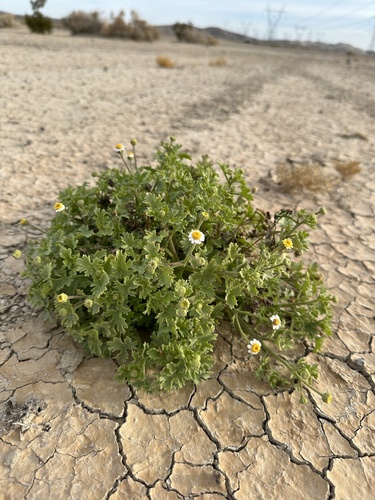
The Emory'S Rockdaisy is a low-growing plant featuring numerous small, bright yellow, daisy-like flower heads that stand out against its often grey-green, toothed leaves. Its compact, bushy form typically carpets rocky desert landscapes.
Category
PlantsRarity
Common
Danger
0/5 · No known danger
Snaps
1
Even though it's a daisy, it loves growing in harsh, rocky desert environments.
Its bright yellow blooms are like sunshine scattered across the desert floor!
The scientific name 'Perityle emoryi' honors a famous American boundary surveyor!
This plant is part of the sunflower family, even with its tiny flowers!
Emory'S Rockdaisy has small, often glandular leaves that help reduce water loss, allowing it to survive in very dry desert habitats.
Emory'S Rockdaisy can grow directly from cracks in rocks, using its strong roots to find nutrients where other plants can't.
Emory'S Rockdaisy can sprout quickly after desert rains, rapidly growing and blooming to take advantage of short-lived moisture.
Apis mellifera
Collects nectar and pollen from flowers
Bombus vosnesenskii
Visits flowers for nectar and pollen
Vanessa cardui
Feeds on flower nectar during migration
Colorful describes organisms or objects displaying a wide range of bright and distinct colors.
Grassland habitats are terrestrial biomes dominated by grasses and herbaceous plants, supporting a variety of grazing animals.
This trait characterizes organisms whose diet consists entirely or primarily of plant material.
Diurnal animals are primarily active during daylight hours, typically resting or sleeping at night.

Describes organisms that transfer pollen, enabling the fertilization and reproduction of plants.
Danger
0/5 · No known danger
No special safety notes yet.
The easiest way to identify Emory'S Rockdaisy is to use the Snappit nature identifier app.
10-60 cm
15-40 cm
0.5-1.5 cm
Winter-Spring
No
None
Perennial
Zoom in to split clusters and explore where this object has been snapped.
Dec 19, 2023
Calico Early Man SitePhoto attribution
(c) Matt Berger, some rights reserved (CC BY)
License: CC BY 4.0 ↗
Image may be shown cropped inside the card frame.

California, US
You might spot Creosote Bush, Desert Holly, and Cottontop Cactus.
View guide →

Arizona, US
You might spot Desert Cottontail, Yellow-Rumped Warbler, and Black Phoebe.
View guide →
Take the discovery with you
Snap it with Snappit to identify it, learn what makes it special, and add the discovery to your collection.









.jpg&width=800)



_001.jpg&width=800)




