





European Hornet
Vespa crabro
The European Hornet is a large wasp that can be found buzzing around gardens and forests. They are important for helping to control pests and pollinating flowers.
Habitat: Forests
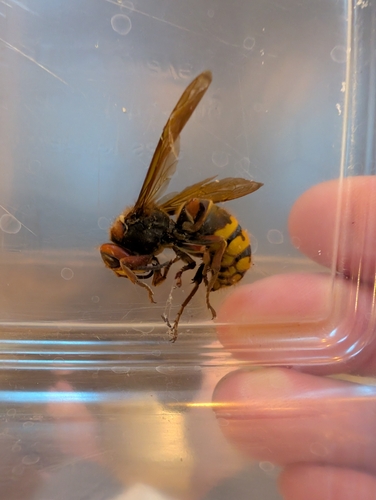
The European Hornet is a large wasp, instantly recognizable by its striking yellow and black striped abdomen, paired with a reddish-brown head and thorax. Its larger size visually distinguishes it from common yellowjackets, which often have more prominent yellow facial markings.
Category
InsectsRarity
Common
Danger
3/5 · Moderate
Snaps
13
A hornet's sting contains alarm pheromones that can attract more hornets to help defend.
European Hornets are one of the few social wasps that are active at night!
Hornet larvae produce a sugary liquid that adult hornets eat, creating a unique food exchange!
They strip tree bark to create a paper-like pulp for building their amazing nests.
European Hornets can deliver a powerful sting to defend their nest because it helps them deter predators and rivals.
The European Hornet has excellent low-light vision that helps them hunt insects even after the sun goes down.
European Hornets can chew through wood and insects with their strong mandibles that help them build nests and process food.
The European Hornet can fly swiftly to catch flying insects because of its powerful wings and sharp eyesight.
These busy insects hunt other insects and enjoy sweet tree sap or ripe fruit!
Musca domestica
controls fly populations as prey
Pernis apivorus
raids nests for larvae and adults
Quercus robur
feeds on tree sap from this species
Vespula vulgaris
competes with and preys on other wasp species
Marked with parallel bands or lines of color.
Social animals live in organized groups, cooperating for survival benefits such as foraging, defense, and raising offspring.
Describes plants that are particularly attractive and beneficial to a wide range of pollinating organisms.
Forest habitats are terrestrial environments dominated by dense tree cover, supporting a high diversity of plant and animal life.

This trait identifies organisms whose diet consists entirely or primarily of animal tissue.

Diurnal animals are primarily active during daylight hours, typically resting or sleeping at night.

Giant describes organisms or objects of significantly larger size than average for their species or type.

Venomous organisms produce toxins that are injected into another animal, typically through a bite or sting.

Describes organisms that transfer pollen, enabling the fertilization and reproduction of plants.
Danger
3/5 · Moderate
If you see a hornet, it's best to stay calm and walk away slowly. Don't swat at them!
The easiest way to identify European Hornet is to use the Snappit nature identifier app.
40-70 mm
20-35 mm
14-365 days
20 km/h
These busy insects hunt other insects and enjoy sweet tree sap or ripe fruit!
Forests
Pursuit
Zoom in to split clusters and explore where this object has been snapped.
May 31, 2026
Colonial Annapolis Historic DistrictPhoto attribution
(c) Lee Hoggard, some rights reserved (CC BY)
License: CC BY 4.0 ↗
Image may be shown cropped inside the card frame.
Virginia, US
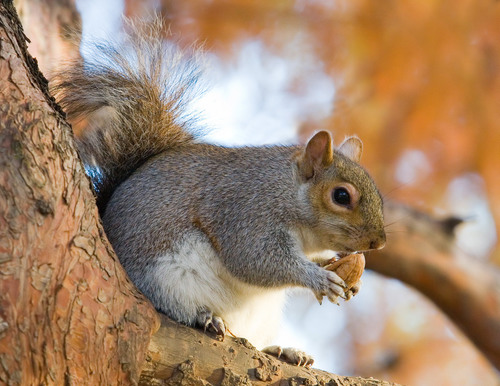
You might spot Eastern Gray Squirrel and Spotted Lanternfly.
View guide →

North Carolina, US
You might spot American Tuliptree and Eastern Tiger Swallowtail.
View guide →

Maryland, US
You might spot Duck, Monarch, and Great Blue Heron.
View guide →

Pennsylvania, US
You might spot American Toad and Spotted Lanternfly.
View guide →
Maryland, US
You might spot Eastern Gray Squirrel and White-Tailed Deer.
View guide →

Indiana, US
You might spot American Robin, Canada Goose, and Eastern Gray Squirrel.
View guide →
Take the discovery with you
Snap it with Snappit to identify it, learn what makes it special, and add the discovery to your collection.








.jpg&width=800)



