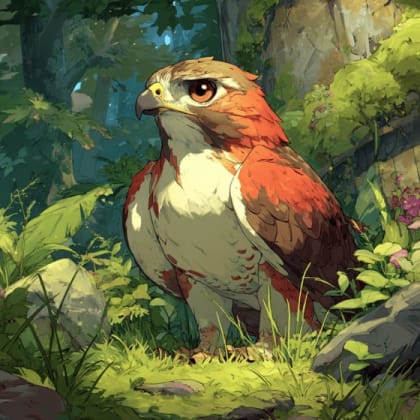





Red Tailed Hawk

The Huguenot Street Historic District offers a profound journey into America's foundational history.
The Huguenot Street Historic District offers a profound journey into America's foundational history. This 10-acre National Historic Landmark District and museum in New Paltz, New York, preserves one of the oldest continuously inhabited streets in the United States, showcasing the legacy of French Huguenot refugees and the diverse cultures that shaped early America. It's a place where 300 years of intertwined histories, from Indigenous peoples to European settlers and enslaved Africans, come vibrantly to life through preserved architecture and compelling narratives.
Visitors can explore seven historic stone house museums, each filled with period artifacts and offering a glimpse into colonial life. Key structures include the Jean Hasbrouck House, a National Historic Landmark famed for its original jambless fireplace, and the DuBois Fort, which now serves as the visitor center. The district also features a reconstructed 1717 French Church, a replica Esopus Munsee wigwam representing the region's Indigenous history, and an early 18th-century burial ground. Beyond the buildings, extensive archives and collections, including African-American history, Civil War items, and colonial manuscripts, provide a rich tapestry of stories.
A visit to Historic Huguenot Street is an immersive educational experience, revealing the architectural evolution from Dutch colonial to Georgian styles and highlighting the resilience and cultural exchange that defined the Hudson Valley. Whether you're a history enthusiast, an architecture admirer, or seeking a unique family outing, the district offers engaging programs and a serene, bucolic setting to reflect on the diverse origins of the nation. It's a memorable destination that inspires new perspectives on American history. Wondering what that bird or insect is? Find out on your visit using the Snappit nature app.
The Huguenot Street Historic District's origins trace back to 1678 when a small group of French Huguenot settlers, fleeing religious persecution in France and present-day Belgium, established a community along the Wallkill River in New Paltz, New York. This settlement, named after the German region "Die Pfalz" where they initially found refuge, was founded after negotiations with the Esopus Indians, whose ancestral lands the site occupies. Archaeological findings at the site indicate Native American habitation dating as far back as 9,000 B.C., making it one of the oldest continuously inhabited settlements in the United States. The commitment to preserving this rich heritage began in 1894 with the founding of Historic Huguenot Street, an organization established by the descendants of the original settlers. They initiated efforts to acquire and protect the historic stone houses, starting with the Jean Hasbrouck House in 1899. Over the decades, the organization acquired most of the remaining 18th-century stone houses, transforming them into museums. The entire street was recognized as a National Historic Landmark District in 1960 and formally added to the National Register of Historic Places in 1966, acknowledging its profound historical and architectural significance.
Take a guided tour to gain in-depth insights into the houses and their former residents. Walk the historic street, utilizing the free walking tour app for self-guided exploration. Visit the DuBois Fort Visitor Center to watch an informational video and browse special exhibitions. Explore the historic burial ground. Immerse yourself in the stories of French Huguenots, Indigenous peoples, Dutch settlers, and enslaved Africans through period rooms and curated exhibits.
During colder months, especially from November to April, some museum houses may not be heated, so dressing warmly is advisable. The site hosts various community events and educational programs throughout the year, with a more robust schedule during the warmer seasons.
Historic Huguenot Street aims to make its grounds and exhibits accessible, though the historic nature of some buildings presents limitations. Wheelchair accessibility is generally available in some areas. Service animals are welcome throughout the site, including inside historic structures. Visitors with limited mobility are encouraged to contact the main office in advance for specific information and assistance.
Don't miss the Jean Hasbrouck House, particularly its rare original jambless fireplace. Explore the Bevier-Elting House to observe its Georgian architectural style and the DuBois Fort which houses the Visitor Center. The reconstructed 1717 French Church and the replica Esopus Munsee wigwam are also essential stops for understanding the diverse cultural narratives of the settlement.
Each card links to a full Explore page with photos, traits, and fun facts.
Start with the big picture, then zoom in to explore individual wildlife observations around this place.
Wear comfortable walking shoes, as the historic district covers a significant area with buildings spread out across roughly eight city blocks.
Park in the designated parking lot on Broadhead Avenue, and follow the directional signs to the DuBois Fort Visitor Center to begin your visit.
Consider downloading the free walking tour app to enhance your experience with additional historical context and archival photos.
Bring a reusable water bottle, especially during warmer months, but remember that food and beverages are not allowed inside the museum houses. A shaded picnic grove is available on the grounds.
Check the official website for current operating hours and tour schedules before your visit, as they can vary seasonally.
If visiting in colder weather, dress in layers or warmly, as some of the historic house museums are not heated.
Jun 6, 2026
Jun 5, 2026
Jun 4, 2026
Jun 4, 2026
Jun 4, 2026

Maryland, US
You might spot White-Tailed Deer and Eastern Gray Squirrel.
View guide →
.jpg)
District of Columbia, US
You might spot Eastern Gray Squirrel, Duck, and House Sparrow.
View guide →

Illinois, US
You might spot American Robin, Canada Goose, and House Sparrow.
View guide →

Virginia, US
You might spot Spotted Lanternfly and Northern Cardinal.
View guide →
Take the discovery with you
Identify the wildlife you spot, learn as you go, and keep a collection of the adventure.