





Five-leaf akebia
Akebia quinata
The Five-leaf Akebia is a climbing plant with beautiful purple flowers. Its leaves have five leaflets, making it look special and unique in gardens and forests.
Habitat: Forests
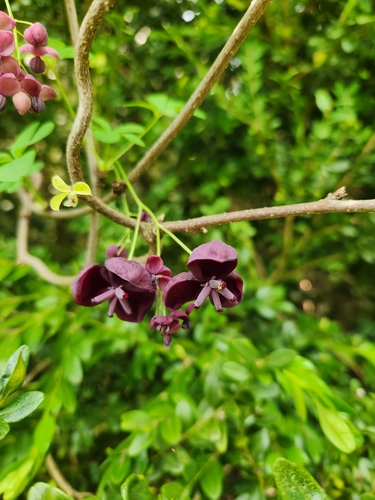
The Five-leaf akebia is a vigorous climbing vine with distinctive palmate leaves, each divided into five oval leaflets. Its small, purplish-brown flowers hang in clusters, often hidden by the foliage, and are followed by unique sausage-shaped, lavender-purple fruits.
Category
PlantsRarity
Common
Danger
1/5 · Very low
Snaps
3
Even its tough, flexible stems were used to make traditional sandals!
Its unusual fruit can split open when ripe, revealing edible, jelly-like pulp!
Japanese farmers once used akebia vines to weave strong, durable baskets!
The young shoots are sometimes stir-fried in Japan, tasting like asparagus!
The Five-leaf akebia can rapidly twine its stems around supports, helping it quickly reach sunlight and outcompete other plants.
Akebia produces unique, sweet fruit that attracts animals, helping spread its seeds far and wide for reproduction.
This plant has robust roots that can store water and nutrients, helping it survive periods of drought effectively.
Apis mellifera
Collects nectar and pollen from its flowers.
Homo sapiens
Consumes its sweet, edible fruit.

Turdus philomelos
May eat ripe fruit, aiding seed dispersal.
Climbing or vine plants are characterized by a growth habit that allows them to ascend upwards by twining, tendrils, or adhesive roots.
Aromatic plants produce and emit fragrant volatile organic compounds, often for defense or to attract pollinators.
Flowering plants are any plants that produce flowers as part of their reproductive cycle.
Fragrant flowers emit a pleasant aroma, often to attract pollinators or for defense.

Fruit-bearing plants produce fruits, which are the mature ovaries of flowering plants containing seeds.

Edible plants are those parts of a plant that are considered safe for human consumption.

Describes plants that are particularly attractive and beneficial to a wide range of pollinating organisms.

Forest habitats are terrestrial environments dominated by dense tree cover, supporting a high diversity of plant and animal life.
No aliases listed yet.
Danger
1/5 · Very low
Always ask an adult before touching or tasting plants.
The easiest way to identify Five-leaf akebia is to use the Snappit nature identifier app.
300-1000 cm
2-3 cm
Spring
Yes
None
Perennial
Insect
Zoom in to split clusters and explore where this object has been snapped.
May 23, 2023
LinwoodPhoto attribution
(c) Judy Dobles, some rights reserved (CC BY)
License: CC BY 4.0 ↗
Image may be shown cropped inside the card frame.
Georgia, US
You might spot Eastern Gray Squirrel, Domestic Cat, and American Robin.
View guide →

Connecticut, US
You might spot American Toad, Wood Frog, and Mountain Laurel.
View guide →

New York, US
You might spot Green Frog, American White Waterlily, and American Toad.
View guide →

Georgia, US
You might spot Eastern Gray Squirrel, Domestic Cat, and American Robin.
View guide →
Georgia, US
You might spot Eastern Gray Squirrel, Domestic Cat, and American Robin.
View guide →
Pennsylvania, US
You might spot Paulownia, Asian Lady Beetle, and Spotted Lanternfly.
View guide →
Take the discovery with you
Snap it with Snappit to identify it, learn what makes it special, and add the discovery to your collection.







.jpg&width=800)


_001.jpg&width=800)



