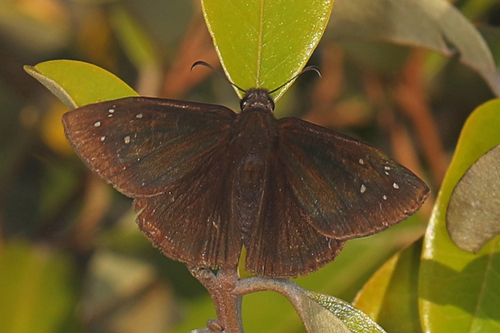


Florida Duskywing
ephyriades brunnea
The Florida Duskywing (Ephyriades brunnea) is an elusive skipper butterfly native to the imperiled pine rocklands of South Florida and the Caribbean. Belonging to the family Hesperiidae, this insect is known for its rapid, darting flight pattern, which makes it appear as a fleeting dark shadow in the forest understory. It maintains a highly specialized ecological relationship with the locustberry plant, which serves as the primary host for its caterpillars. While they may seem unassuming at first glance, these butterflies are vital indicators of healthy, fire-dependent subtropical ecosystems, and spotting one requires both patience and a keen eye.
Habitat: Found in endangered pine rocklands, subtropical hardwood hammocks, and forest edges where its larval host plant is abundant.
This skipper butterfly features a wingspan of about 3.5 to 4.5 centimeters and a characteristically robust, moth-like body. Males are predominantly dark, velvety brown to near-black with small, faint translucent white spots on the forewings, while females are lighter brown with larger, highly visible translucent spots. When resting, they typically hold their wings completely flat or slightly angled, showing a mottled underside that mimics dead foliage.
Category
InsectsRarity
Common
Danger
1/5 · Very low
Snaps
Be the first to snap!
The Florida Duskywing is highly dependent on periodic wildfires, which help maintain the open pine rockland habitats they require.
The caterpillars are nocturnal feeders, remaining securely hidden inside their self-constructed silk leaf-shelters during the daytime.
Unlike most butterfly species that rest with their wings closed vertically, duskywings prefer to rest with their wings completely flat.
Utilizes extremely strong thoracic muscles to execute rapid, zig-zagging aerial maneuvers, allowing it to easily evade predators.
Caterpillars spin fine silk to fold and bind host plant leaves together, creating a secure, hidden capsule to shelter from predators.
When resting flat against branches or leaf litter, the dark, mottled undersides of its wings camouflage it perfectly as dead vegetation.
Larvae feed exclusively on the leaves of specific host plants in the Malpighiaceae family, while adults consume flower nectar.
Age differences: Larvae are leaf-eating folivores restricted to host plants, whereas adults are generalist nectar-feeders visiting various wildflowers.

Byrsonima lucida
The primary larval host plant where females lay eggs and caterpillars feed.

Bidens alba
Adult butterflies feed on the nectar of this plant, assisting in pollination.
Anolis carolinensis
A common reptile predator that preys upon adult duskywings resting in the understory.
No trait badges are assigned for this object yet.
No aliases listed yet.
Collections for this object will appear here as more themes are added.
Danger
1/5 · Very low
No special safety notes yet.
Compare the wing outline, spots, bands, eyespots and wing edges. The underside can look completely different from the top. Check for tails, the antennae and where the markings sit instead of relying on color alone. Butterfly Identifier: upload a photo and compare the visible details.
2-3 cm
3-5 cm
0.0001-0.0003 kg
0 years
20 km/h
Larvae feed exclusively on the leaves of specific host plants in the Malpighiaceae family, while adults consume flower nectar.
Found in endangered pine rocklands, subtropical hardwood hammocks, and forest edges where its larval host plant is abundant.
Zoom in to split clusters and explore where this object has been snapped.
Recent snaps will appear here as new observations are added.
Take the discovery with you
Snap it with Snappit to identify it, learn what makes it special, and add the discovery to your collection.