

Florida Tree Snail
liguus fasciatus
The Florida Tree Snail (Liguus fasciatus), often referred to as the "living jewel" of the Everglades, is a remarkable species of air-breathing land snail native to South Florida and Cuba. Historically revered by indigenous peoples and highly prized by collectors for their extraordinarily vibrant shells, these mollusks are a testament to the isolated evolutionary microhabitats of tropical hardwood hammocks. They spend their entire lives in the canopy of smooth-barked trees, harmoniously grazing on microscopic growth without causing any harm to their hosts. Beyond their aesthetic appeal, Florida Tree Snails play a vital role in their ecosystem by cleaning tree bark of fungi and lichens. During the dry winter months, they enter a state of dormancy called aestivation, securely gluing themselves to branches to conserve moisture. Unfortunately, habitat loss and historical over-collection have threatened their populations, making every sighting of these kaleidoscopic snails a rare and treasured experience for nature enthusiasts.
Habitat: Found exclusively in tropical hardwood hammocks, where they reside on the smooth bark of trees like wild tamarind and Jamaican dogwood.
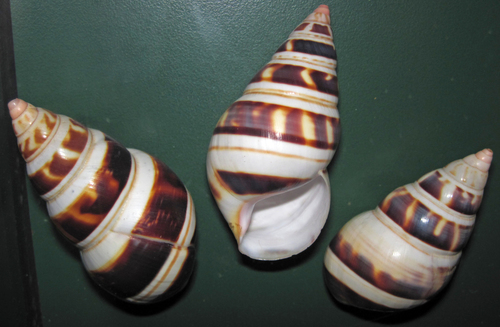
The Florida Tree Snail is most easily identified by its conical, elongated shell, which measures between 4 and 7 centimeters in length. The shell is famously polymorphic, meaning it exhibits over 50 recognized color varieties. While the base color is often white or cream, the shell is typically adorned with striking, spiraling bands of vibrant pink, emerald green, bright yellow, rich orange, brown, or black. The snail's soft body is usually a pale, translucent gray or brownish color, featuring two pairs of tentacles on its head, with the upper pair bearing the eyes.
Category
InvertebrateRarity
Common
Danger
1/5 · Very low
Snaps
Be the first to snap!
Because of their brilliant and highly varied shell patterns, Florida Tree Snails are famously nicknamed the 'living jewels' of the Everglades.
During the dry season, the snail essentially glues itself to a branch with a substance called 'epiphragm', remaining entirely dormant until the summer rains arrive.
Historically, Native American tribes in South Florida utilized the vibrant shells of these snails to create decorative jewelry and ceremonial ornaments.
There are over 50 named color varieties of the Florida Tree Snail, a result of isolated populations evolving on different 'tree islands' throughout the Everglades.
To survive the dry winter months, the snail secretes a special mucus called an epiphragm that hardens to glue its shell to a tree branch, preventing dehydration.
Its radula (a tongue-like organ with tiny teeth) is perfectly adapted to scrape microscopic algae and lichens without damaging the underlying tree bark.
The extreme variation in shell colors and patterns across different hammock islands helps specific populations blend into their localized environments and confuse visual predators.
The Florida Tree Snail grazes on microscopic plant and fungal life found on the surface of smooth-barked trees.
Age differences: Hatchlings feed on softer algae near the ground before climbing into the canopy to consume tougher lichens as adults.
Lysiloma latisiliquum
Provides a smooth-barked surface for the snail to live on and graze.

Procyon lotor
A major predator that actively hunts and cracks open the snail's shell for food.

Rattus rattus
An invasive predator that climbs hammock trees to prey on adult and juvenile snails.
No trait badges are assigned for this object yet.
No aliases listed yet.
Collections for this object will appear here as more themes are added.
Danger
1/5 · Very low
No special safety notes yet.
Compare body symmetry, shells, segments, legs, tentacles and how the animal moves. Invertebrates span many unrelated groups, so start with body structure. Invertebrate Identifier: upload a photo and compare the visible details.
4-7 cm
0.01-0.03 kg
2-7 years
The Florida Tree Snail grazes on microscopic plant and fungal life found on the surface of smooth-barked trees.
Found exclusively in tropical hardwood hammocks, where they reside on the smooth bark of trees like wild tamarind and Jamaican dogwood.
Foraging
15-50
Zoom in to split clusters and explore where this object has been snapped.
Recent snaps will appear here as new observations are added.
Take the discovery with you
Snap it with Snappit to identify it, learn what makes it special, and add the discovery to your collection.