
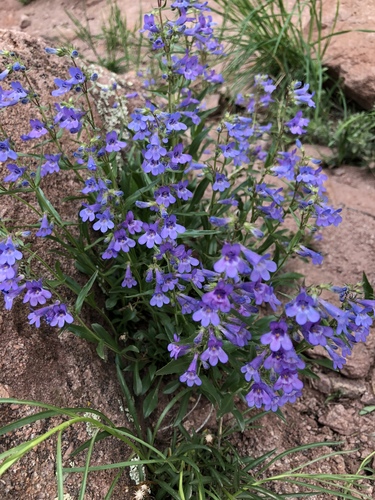


Front Range Beardtongue
penstemon virens
The Front Range Beardtongue, Penstemon virens, is a charming perennial wildflower native to the foothills and montane zones of the central Rocky Mountains. This resilient plant is a true harbinger of early summer, gracing the landscape with its striking blue-purple blooms. It plays a vital ecological role, providing nectar for a variety of pollinators and contributing to the biodiversity of its harsh, dry habitats. Its ability to thrive in poor, rocky soils makes it a testament to adaptation and a significant component of the Front Range's unique flora.
Habitat: Found on dry, open, rocky slopes, ponderosa pine woodlands, and well-drained meadows in foothills and montane environments.
This species typically grows as an upright forb, reaching heights of 15 to 45 centimeters. Its most distinctive feature is the tubular, vibrant blue-purple to violet flowers, often with a white or lighter throat, arranged in loose, upright clusters (racemes) along the stem. The leaves are linear to lance-shaped, smooth-edged, and typically bright green, with most leaves appearing at the base of the plant and smaller, opposite leaves along the flowering stem. The overall appearance is slender yet sturdy, with a burst of color from its numerous blooms.
Category
PlantsRarity
Common
Danger
1/5 · Very low
Snaps
Be the first to snap!
It is a member of one of the largest genera of flowering plants endemic to North America, with over 250 species showing incredible diversity in flower shape and color.
Penstemon virens is a popular choice for xeriscaping and native plant gardens due to its drought tolerance, vibrant flowers, and low maintenance requirements.
The genus name 'Penstemon' comes from the Greek words 'pente' (five) and 'stemon' (stamen), referring to the five stamens, one of which is sterile and often hairy, resembling a 'beardtongue'.
The sterile stamen, or staminode, serves a crucial role in guiding pollinators deeper into the flower to reach the nectar and pollen.
The plant is highly adapted to arid conditions, possessing mechanisms to conserve water and thrive in rocky, well-drained soils where moisture can be scarce.
Its uniquely shaped, brightly colored flowers are specifically evolved to attract long-tongued bees and other native pollinators, ensuring efficient reproduction.
Penstemon virens excels in poor, gravelly, or sandy soils with low nutrient content, often establishing itself in cracks and crevices among rocks.
As a photosynthetic plant, Penstemon virens produces its own food using sunlight, water, and carbon dioxide, absorbing essential mineral nutrients from the soil.
Bombus occidentalis
Provides nectar and pollen as a food source for adult insects.

Odocoileus hemionus
Herbivore feeding on foliage, especially young shoots.

Glomus intraradices
Forms a beneficial symbiotic relationship, helping the plant absorb nutrients from the soil.

Peromyscus maniculatus
Herbivore feeding on foliage and flowers.
No trait badges are assigned for this object yet.
No aliases listed yet.
Collections for this object will appear here as more themes are added.
Danger
1/5 · Very low
No special safety notes yet.
Start with the whole plant, then compare leaf arrangement, leaf edges, stems and any flowers or fruit. Opposite leaves grow in pairs; alternate leaves come one at a time along the stem. These details tell you far more together than a single green leaf does. Plant Identifier: upload a photo and compare the visible details.
15-45 cm
3-8 years
As a photosynthetic plant, Penstemon virens produces its own food using sunlight, water, and carbon dioxide, absorbing essential mineral nutrients from the soil.
Found on dry, open, rocky slopes, ponderosa pine woodlands, and well-drained meadows in foothills and montane environments.
Absorption
Zoom in to split clusters and explore where this object has been snapped.
Recent snaps will appear here as new observations are added.

Colorado, US
You might spot Common Starlily and Wholeleaf Paintbrush.
View guide →

Colorado, US
You might spot Elk, Mule Deer, and Black-Billed Magpie.
View guide →

Colorado, US
You might spot Front Range Beardtongue and Mountain Ball Cactus.
View guide →
Take the discovery with you
Snap it with Snappit to identify it, learn what makes it special, and add the discovery to your collection.


















