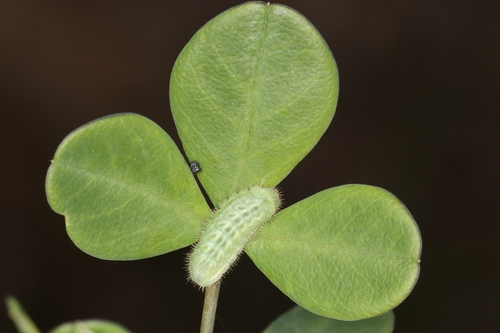


Frosted Elfin
callophrys irus
The Frosted Elfin (Callophrys irus) is a small, elusive, and increasingly rare butterfly belonging to the gossamer-winged family, Lycaenidae. Known for its highly localized populations, this fascinating insect acts as an important biological indicator for the health of specialized, fire-maintained habitats like pine barrens and oak savannas. Because it rarely strays far from its specific host plants, discovering a Frosted Elfin is a rewarding experience for naturalists and a strong sign of ecological preservation. What makes the Frosted Elfin particularly interesting is its fragile dependence on the environment. It relies heavily on periodic, low-intensity natural fires that clear out dense forest canopies, allowing its host plants—such as wild lupine and wild indigo—to thrive. As human development and fire suppression have altered these landscapes, the Frosted Elfin has become a symbol of the vital connection between natural disturbance regimes and biodiversity.
Habitat: Found primarily in open woods, pine barrens, oak savannas, and brushy fields where its host plants, wild lupine or wild indigo, grow abundantly.
The Frosted Elfin is a small butterfly with a wingspan ranging from 2 to 3 centimeters. It lacks the prominent tails often seen on the hindwings of other hairstreak butterflies. The dorsal (top) side of its wings is typically a uniform grayish-brown in males and a warmer reddish-brown in females. Its defining feature, which gives the species its name, is found on the ventral (underside) of the hindwings: a distinct 'frosted' or hoary marginal area of grayish-white scales. This frosty edge is bordered by an irregular, dark postmedian line, and there is usually a distinct dark spot near the lower outer margin of the hindwing.
Category
InsectsRarity
Common
Danger
1/5 · Very low
Snaps
Be the first to snap!
It is a 'univoltine' species, meaning it produces only one generation per year, with adults emerging to fly for just a few short weeks in early spring.
The Frosted Elfin gets its name from the grayish-white scaling on the edges of its hindwings, making it look as though it has been lightly dusted with morning frost.
They are notoriously weak flyers and rarely travel more than a few hundred meters from the exact spot where they hatched.
Unlike many butterflies that overwinter attached to branches, the Frosted Elfin's chrysalis rides out the winter buried loosely in the leaf litter near its host plant.
The Frosted Elfin survives harsh winter conditions by entering a state of suspended animation as a chrysalis, buried safely in the leaf litter rather than hanging from a branch.
To regulate its body temperature on cool spring mornings, the butterfly closes its wings and tilts them laterally toward the sun, maximizing heat absorption.
Its caterpillars possess specialized digestive enzymes that allow them to feed exclusively on a few specific legumes, bypassing the plants' natural chemical defenses.
Larvae are specialist feeders on specific legume plants, while adult butterflies consume nectar from a variety of early spring flowers.
Age differences: Caterpillars chew the flowers, seed pods, and leaves of their host plants, whereas mature adults use their proboscis to sip liquid nectar.

Lupinus perennis
Provides essential food and exclusive egg-laying sites for the butterfly.
Baptisia tinctoria
Serves as an alternative host plant for the caterpillars in parts of its range.
Formica subsericea
Ants often tend to the caterpillars, providing protection from predators in exchange for sweet honeydew secretions.

Misumena vatia
An ambush predator that frequently hunts adult butterflies resting on flowers.
No trait badges are assigned for this object yet.
No aliases listed yet.
Collections for this object will appear here as more themes are added.
Danger
1/5 · Very low
No special safety notes yet.
Compare the wing outline, spots, bands, eyespots and wing edges. The underside can look completely different from the top. Check for tails, the antennae and where the markings sit instead of relying on color alone. Butterfly Identifier: upload a photo and compare the visible details.
1-2 cm
2-3 cm
0.0001-0.0003 kg
1 years
10 km/h
Larvae are specialist feeders on specific legume plants, while adult butterflies consume nectar from a variety of early spring flowers.
Found primarily in open woods, pine barrens, oak savannas, and brushy fields where its host plants, wild lupine or wild indigo, grow abundantly.
Zoom in to split clusters and explore where this object has been snapped.
Recent snaps will appear here as new observations are added.
Take the discovery with you
Snap it with Snappit to identify it, learn what makes it special, and add the discovery to your collection.