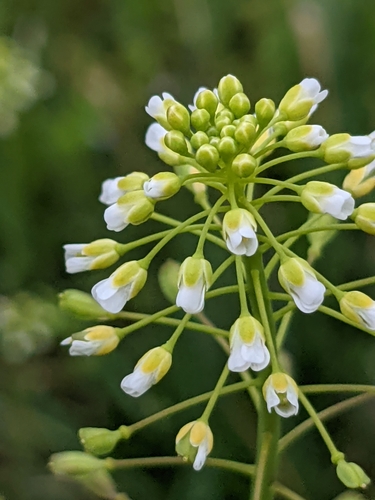


Garlic Penny-Cress
mummenhoffia alliacea
Garlic Penny-Cress (Mummenhoffia alliacea) is an intriguing annual or biennial herbaceous plant belonging to the mustard family (Brassicaceae). It is particularly known for the distinct garlicky aroma emitted when its leaves are crushed, a natural defense mechanism against herbivores. This species serves as a resilient pioneer in disturbed environments, demonstrating adaptability and a capacity for rapid colonization. Despite its commonality, its unique combination of small white flowers and characteristic disc-shaped seed pods, alongside its potent scent, makes it an engaging subject for those interested in botany and the diverse strategies plants employ for survival and reproduction.
Habitat: Garlic Penny-Cress thrives in disturbed ground, open woodlands, forest edges, cultivated fields, roadsides, and waste areas, often preferring nutrient-rich, well-drained soils.
This slender plant typically grows 15-40 cm tall, featuring upright stems that can be branched. Basal leaves are often spatulate to ovate and form a rosette, while stem leaves are smaller, sessile, and clasping, with finely toothed margins. The small, cruciform (four-petaled) white flowers are arranged in dense terminal racemes. The most distinctive identifying feature, apart from the garlicky scent, are the mature fruits: flattened, orbicular to oval, winged silicles that resemble small, green to light brown pennies, giving the plant its 'penny-cress' moniker.
Category
PlantsRarity
Common
Danger
1/5 · Very low
Snaps
1
Despite its strong aroma, Garlic Penny-Cress is not typically used as a culinary herb and is more often regarded as a weed in gardens and agricultural fields.
The 'penny' in its common name refers to the plant's unique, flat, and round seed pods, which resemble old European coins.
The distinctive garlic-like scent is produced by glucosinolates, sulfur-containing compounds common in the mustard family, which break down to release volatile defense chemicals.
The genus name 'Mummenhoffia' was established relatively recently in 2011, honoring Professor Klaus Mummenhoff, a German botanist known for his work on Brassicaceae.
Upon physical damage or crushing, the plant releases a strong garlic-like odor due to sulfur compounds, effectively deterring many generalist herbivores.
As an annual or biennial, it produces a large number of seeds, enabling it to quickly establish and colonize disturbed or bare ground, acting as an effective pioneer species.
It demonstrates high resilience, capable of growing in a wide range of soil types and varying light conditions, from full sun to partial shade, which contributes to its widespread presence.
As a photosynthetic plant, Garlic Penny-Cress synthesizes its own food by converting sunlight, carbon dioxide, and water into sugars, while also absorbing essential nutrients from the soil through its root system.
Apis mellifera
Pollinates its flowers, aiding in reproduction.
Pieris rapae
Larvae feed on the foliage of Brassicales species, including penny-cress.

Cornu aspersum
Generalist herbivores that consume leaves and stems.
No trait badges are assigned for this object yet.
No aliases listed yet.
Collections for this object will appear here as more themes are added.
Danger
1/5 · Very low
No special safety notes yet.
The easiest way to identify Garlic Penny-Cress is to use the Snappit nature identifier app.
15-40 cm
0.01-0.05 kg
1-2 years
As a photosynthetic plant, Garlic Penny-Cress synthesizes its own food by converting sunlight, carbon dioxide, and water into sugars, while also absorbing essential nutrients from the soil through its root system.
Garlic Penny-Cress thrives in disturbed ground, open woodlands, forest edges, cultivated fields, roadsides, and waste areas, often preferring nutrient-rich, well-drained soils.
Photosynthesis And Nutrient Absorption
500-5000
Zoom in to split clusters and explore where this object has been snapped.
Take the discovery with you
Snap it with Snappit to identify it, learn what makes it special, and add the discovery to your collection.













.jpg&width=800)



_001.jpg&width=800)




